
As an Amazon Associate, Chasing Cherry Blossoms earns from qualifying purchases. We may also earn from other affiliate links on this page at no extra cost to you.
What Is the Time in Japan?
When I first planned a trip to Japan, “what time is it there?” was one of my first questions. The answer is pleasantly simple: the whole country runs on a single time zone. This guide covers that time zone, how to convert it from home, and how time works on the ground, from famously punctual trains to shop opening hours and cherry blossom timing.
The Short Answer: Japan Standard Time (JST)
Japan uses Japan Standard Time (JST), which is UTC+9. It is the same everywhere in the country, from Hokkaido in the north to Okinawa in the south. You never need to change your watch when you travel between cities.
One correction to a common myth: there is no separate “Japan Daylight Time” in use today, and the Ogasawara Islands also use JST. Japan has one time zone.
Does Japan Have Daylight Saving Time?
No. Japan does not observe daylight saving time today, so the clocks do not change in spring or autumn. DST was briefly tried during the Allied occupation after World War II, in the late 1940s and early 1950s, and was then dropped. Debate about reintroducing it comes up from time to time, mostly around energy saving, but nothing has changed for travelers.
Because Japan stays fixed all year, the time difference with your home country can change twice a year if your country uses DST. Check the difference close to your travel dates.
Time Difference Between Japan and Other Countries
Japan is ahead of most of the world, so it is already “tomorrow” there when you are finishing your day. Rough guides:
- UK: Japan is 9 hours ahead in winter and 8 hours ahead during British Summer Time.
- US East Coast (New York): 14 hours ahead in winter (EST) and 13 hours ahead during US daylight saving time. I recommend checking, because it is easy to mix these up.
- US West Coast (Los Angeles): roughly 16 to 17 hours ahead depending on the season.
- Sydney, Australia: Sydney is 1 hour ahead of Tokyo in Australian winter and 2 hours ahead during Australian daylight saving.
To avoid mistakes, add Tokyo as a second clock on your phone, or use an online time zone converter. This is handy for booking flights and calling home, and for remembering that a 9:00 meeting in Tokyo is the previous evening in the US.
How Time Works Day to Day in Japan
12-hour and 24-hour clocks
In conversation people usually say the time in a 12-hour style with gozen (morning, AM) and gogo (afternoon, PM). Train timetables, bus schedules and many reservations use the 24-hour clock, so 18:30 means 6:30 pm. Some late-night schedules, such as bars and TV listings, even run past 24:00 (for example 25:00 for 1 am).
Punctuality is a big deal
Arriving on time matters in Japan, and arriving a few minutes early is considered polite. Trains are the clearest example. Departures are timed to the minute, and a delay of even a few minutes often gets an announcement or an apology. For travelers this is great news, because you can plan tight connections with confidence. It also means you should be on the platform before your train, not running up as it leaves.
Useful opening hours
- Department stores and shops: typically about 10:00 to 20:00, though hours vary by store.
- Convenience stores: many are open 24 hours.
- Temples and shrines: many open in the morning and close in the late afternoon, but closing times vary by site and season. Check the official page before you go.
- Restaurants: many close between lunch and dinner, and some places take last orders well before closing.
- Last trains: in big cities last services usually leave before or around midnight, and the exact time varies by line and station. Missing one means a taxi or an overnight stay, so check your route.
Timekeeping in Japan’s History
Standard time arrives
Before the Meiji era, local time was based on the sun. As railways and communication grew, a national standard was needed. JST was set in the 1880s, with an imperial ordinance issued in 1886 (in effect from 1888) based on the meridian 135 degrees east, which passes through Akashi in Hyogo Prefecture.
Traditional clocks
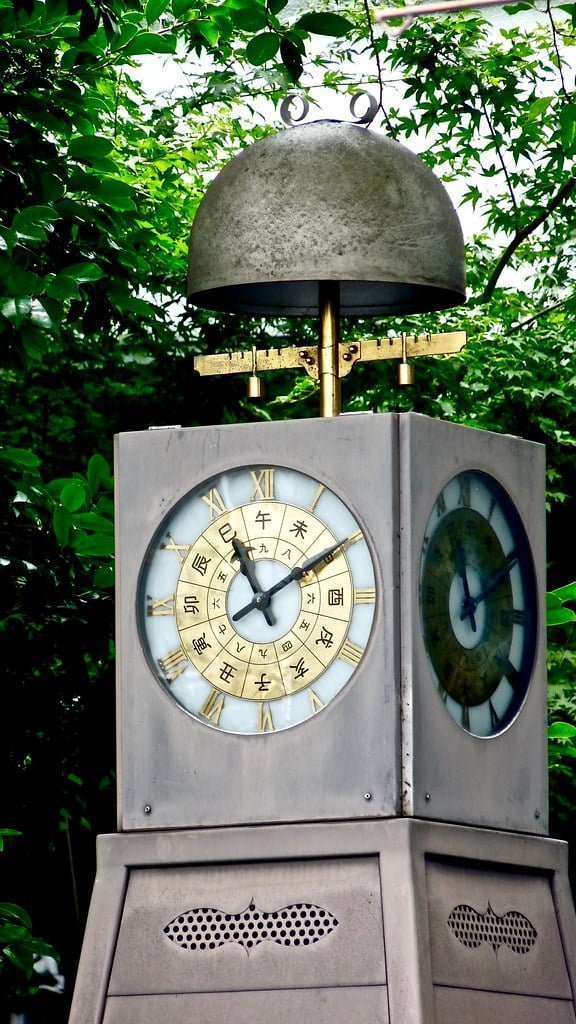
Early timekeeping included water clocks and sundials. Mechanical clocks arrived from Europe and were treasured luxury items. In the Edo period (1603 to 1868), the Japanese developed the wadokei, a mechanical clock adapted to the traditional system where the length of an “hour” changed with daylight through the seasons. You can still see them in museums and some temples.
Handy Time Words in Japanese
- Ichiji means one o’clock.
- Gozen means AM (morning), and gogo means PM (afternoon).
- Jikan ni maniau means to be in time.
- Jikan o mamoru means to keep to the time, that is, to be punctual.
Timing Your Trip: Seasons, Sakura and Passes
When do the cherry blossoms bloom?
Sakura follow the weather, not the calendar. In general, trees in Tokyo and Kyoto bloom from late March to early April, warmer southern areas such as Kyushu bloom earlier, and northern areas such as Hokkaido bloom in late April or May. Forecasts are published each year from late winter, so check the latest one when you book. Peak bloom usually lasts only about a week, so build some flexibility into your plans. If you are looking for places to stay, note that hotels fill up early in this season. For a season-by-season breakdown, see my guide to the best time to visit Japan.
Do you need a JR Pass?
Since the price rise in October 2023, the nationwide JR Pass is much more expensive. A 7-day ordinary pass costs 50,000 JPY when bought on the official site (Green car 70,000 JPY). Exchange orders from overseas agents cost slightly more, and Nozomi and Mizuho trains need an extra ticket. Because trains run on time and connections are reliable, the pass can still work well for a long multi-city trip, but for a simple Tokyo to Kyoto round trip, individual tickets are often cheaper. Add up your planned journeys before buying.
Jet lag and staying connected
Coming from the Americas or Europe, expect a few days of jet lag. Getting daylight in the morning helps. An eSIM or pocket Wi-Fi makes it easy to check train times and keep the clock on your phone updated as soon as you land. Japan uses the same two-pin plugs as North America, so travelers from other regions may want a travel plug adapter.
Summary
Japan has one time zone (JST, UTC+9), no daylight saving, and a culture that values being on time. Convert the time difference before you book flights and calls, keep an eye on opening hours and last trains, and plan your sakura dates with some flexibility.
FAQ
What time zone is Japan in?
Japan Standard Time (JST), which is UTC+9, across the whole country.
Does Japan observe daylight saving time?
No. Clocks stay the same all year.
What is the time difference between Japan and the United States?
It depends on where you are. Tokyo is about 13 to 14 hours ahead of New York and about 16 to 17 hours ahead of Los Angeles, depending on US daylight saving time.
What is the time difference between Japan and the United Kingdom?
Japan is 9 hours ahead of the UK in winter and 8 hours ahead during British Summer Time.
What is the time difference between Japan and Australia?
Sydney is 1 hour ahead of Japan in Australian winter and 2 hours ahead during Australian daylight saving. Brisbane has no daylight saving and is always 1 hour ahead, and Perth is 1 hour behind.
What is the current time in Japan?
Search “time in Tokyo”, or add Tokyo as a clock in your phone’s world clock. It is the same time everywhere in Japan.