
Disclosure: this post may contain affiliate links. If you buy through them, Chasing Cherry Blossoms may earn a commission at no extra cost to you. Affiliate disclosure.
If you drive on a Japanese expressway viaduct, you will commonly see evenly spaced lines across the lane and feel a bump in the road as the car goes over them. We wanted to learn more about those joints: whether they are really necessary, and whether they help when the ground shakes. So we looked up the official bridge specifications and operator data, and this is what they say.
Quick answer: Yes, the joints are necessary. Steel and concrete decks lengthen and shorten with temperature, concrete slowly shrinks after it is poured, and traffic makes spans flex, so the deck needs a gap to move in, and the joint device keeps the road driveable and water out. They also let the deck move in a quake, but they are not the main fall-prevention system. That job belongs to seat length plus unseating-prevention devices, strengthened after the 1995 Kobe (Hyogo-ken Nanbu) earthquake. In a large quake the joints themselves may be damaged, and they are designed to be replaceable. The regular bump you feel on an urban viaduct is usually normal.
What those joints actually are
The official Japanese name is shinchuku sochi (伸縮装置), which simply means “expansion joint.” It is the gap, and the device that spans the gap, where one section of a bridge deck meets the next or meets the abutment at the end of the bridge. The rules for them sit in the Japan Road Association’s Specifications for Highway Bridges (Part I, clause 10.3 in the 2017 English edition), and I read that text in November 2026.
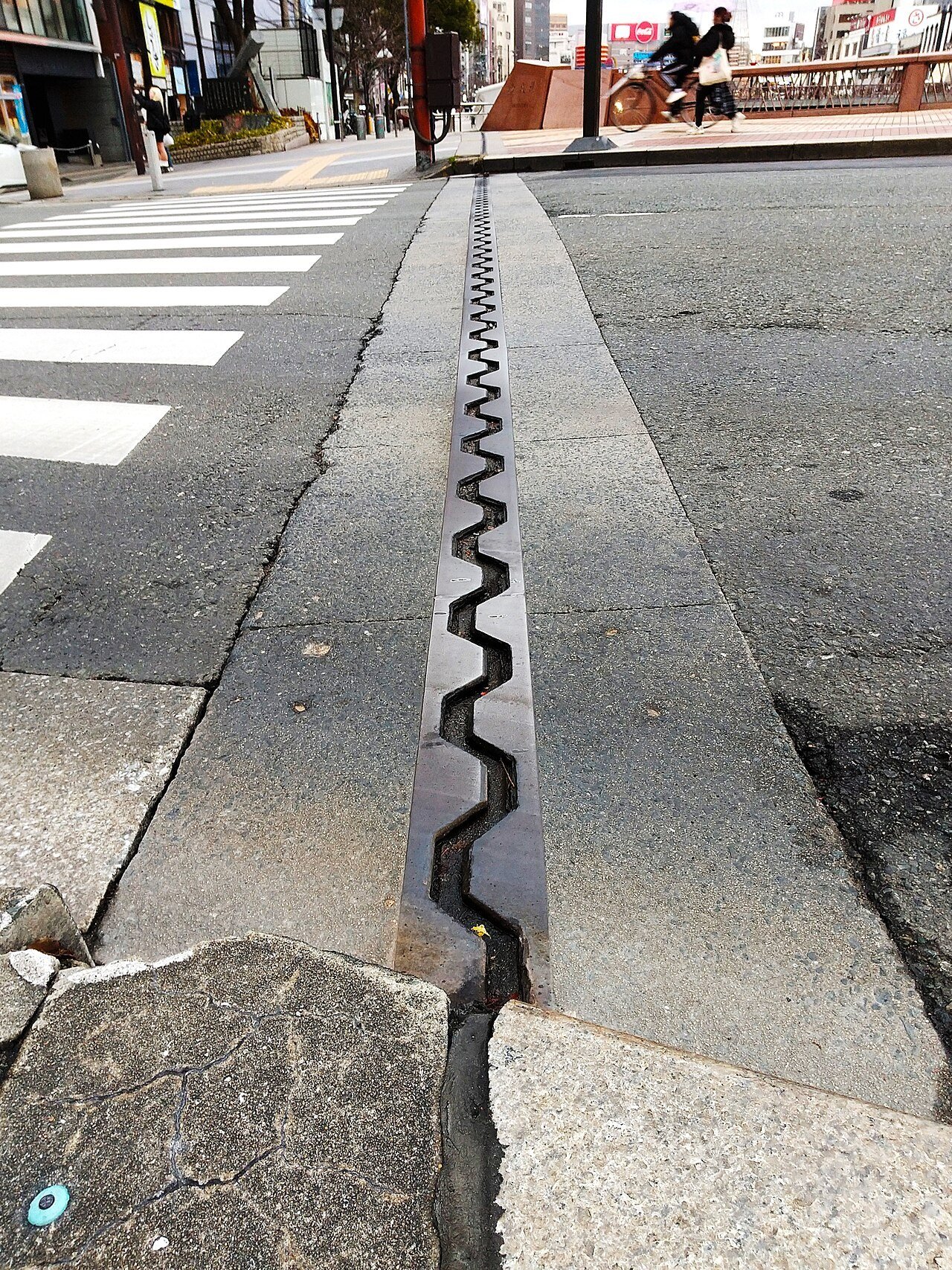
The specification says expansion joints must be selected so that the road surface stays smooth, continuous and strong enough for vehicles to travel without problems; so that they last under traffic; so that rainwater cannot get through; so that noise and vibration from traffic are considered; and so that the surface keeps an appropriate level of skid resistance.
It also says what the joint has to accommodate. The design movement is set by girder temperature changes, concrete creep and drying shrinkage, movement of the superstructure as it deflects under traffic loads, and an allowance for construction error. In plain English: a deck is longer on a hot afternoon than on a cold night, new concrete keeps shrinking slowly after it is poured, and a heavy truck makes a span flex a little. Without a place for all that movement to go, something would eventually crack or push.
One more detail I liked: the specification expects joints to be inspected and replaced during the life of a bridge, and designers are told to think about how that will be done. So a joint is a hard-working, wear-prone part, not something fitted once and forgotten. The spec also treats steel finger (comb-shaped) joints, a common type, as taking a heavier impact allowance than rubber-and-steel types, which fits with how much punishment they take from wheels.
Why Japan’s expressways seem to have so many
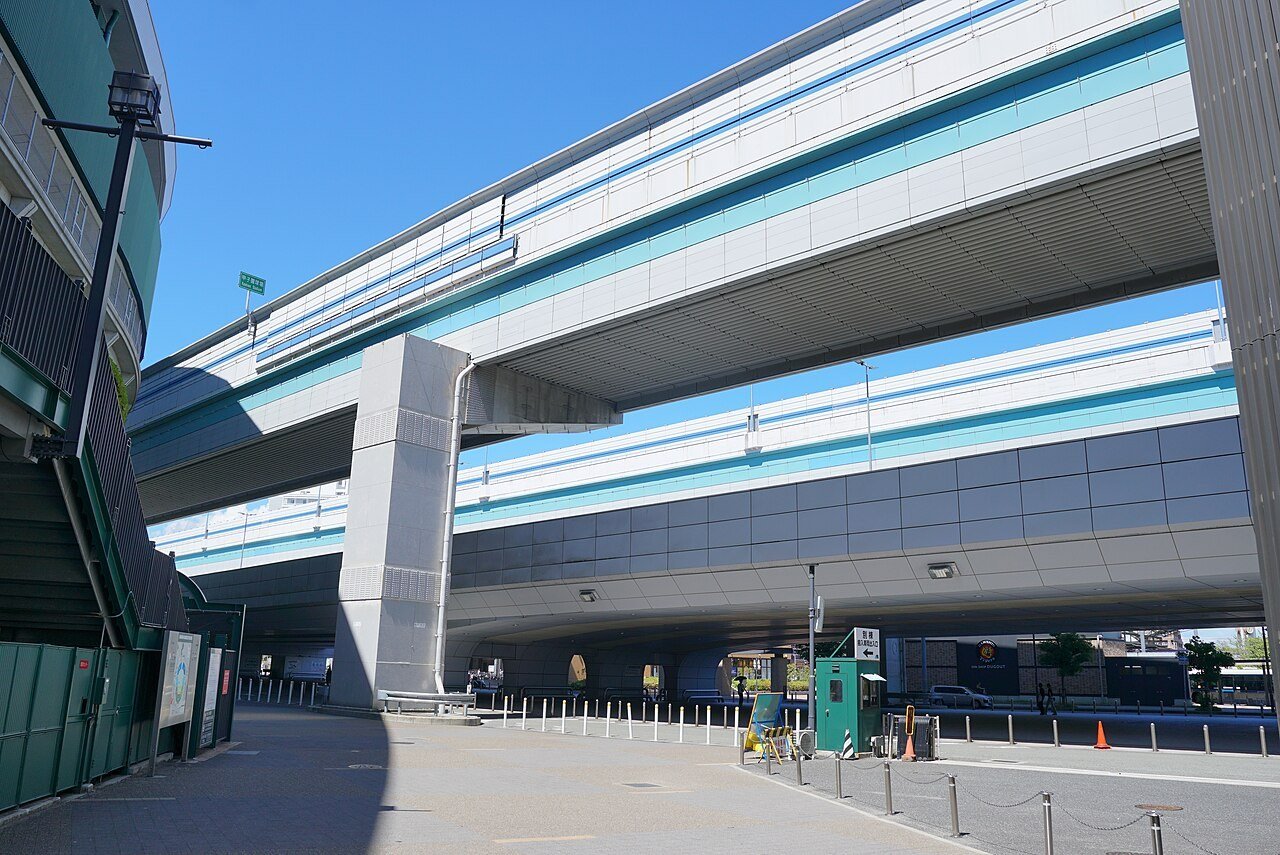
Joints sit at the ends of girder units and at abutments. Urban expressways in Japan are mostly elevated, so a short drive can cross a lot of spans, and each one can mean a bump in the road. Official figures show how much of the big city networks is structure rather than ground-level road.
| Network | Official figure | As of | Source |
|---|---|---|---|
| Hanshin Expressway (Osaka-Kobe) | 258.1 km in service; 202.1 km of it bridges (78.3%) | End of March 2025 | Hanshin FY2024 maintenance report |
| Metropolitan Expressway (Shutoko, Tokyo area) | About 327 km; about 95% structures such as viaducts and tunnels | FY2022 | Shutoko data page |
| NEXCO national expressways (for contrast) | 7,832 km; viaducts 1,156 km (15%) | April 2012 | MLIT committee material |
Hanshin Expressway’s maintenance report for FY2024 lists 258.1 km in service as of the end of March 2025, with 202.1 km (78.3%) on bridges, 32.4 km (12.6%) in tunnels and 23.6 km (9.1%) as earthwork. Its data page gives 9,797 spans, where a span is the section between the piers that support the girders. I want to be careful here: that is a count of spans, not of joints, because bridges built continuous over several spans have fewer joints than spans. But with nearly 10,000 spans on a mostly elevated urban expressway, a joint comes around often.
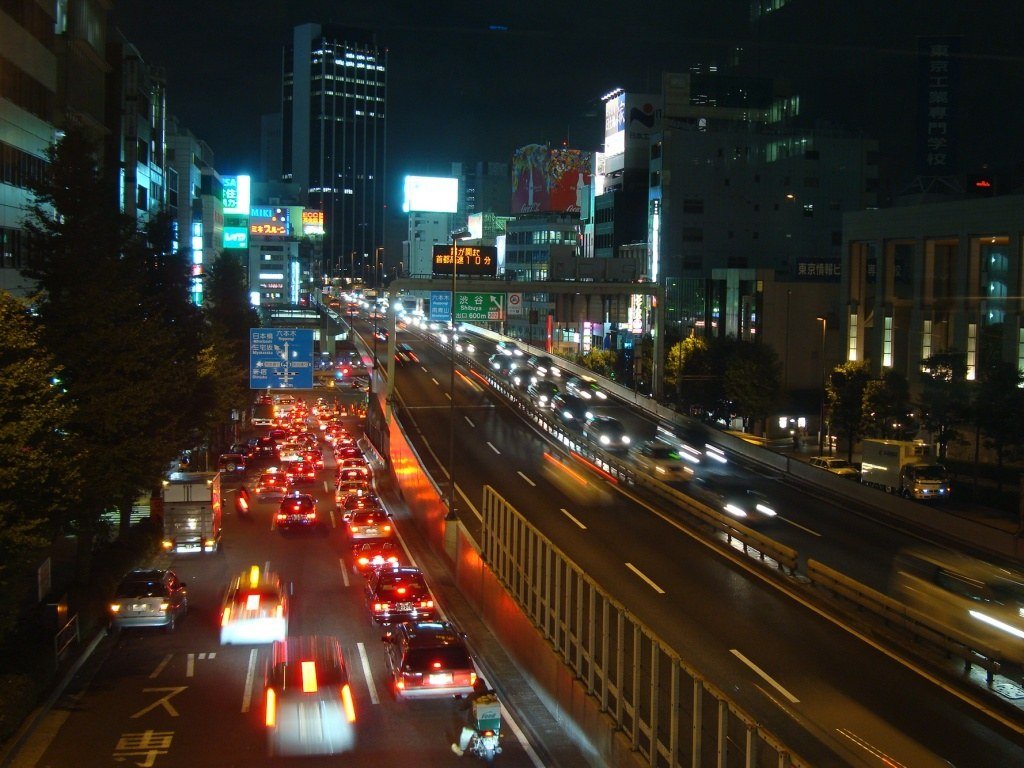
Tokyo is similar. Metropolitan Expressway’s data page gives about 327 km in total for FY2022, with about 95% of the network being structures that need careful maintenance, such as viaducts and tunnels, and about 1 million vehicles a day.
The national contrast is older, so I am dating it. An MLIT committee document showed that as of April 2012 only 15% of NEXCO’s national expressway length was viaduct (1,156 km of 7,832 km), with most of the rest on earthwork. Out in the countryside the road mostly sits on the ground, while in Tokyo, Osaka and Kobe it is mostly in the air. That is why the bump is especially easy to feel in the big cities. I would not read 2012 figures as today’s totals, only as the pattern.
Do they help in earthquakes?
This is where I wanted to be precise, because it is easy to overclaim. The honest answer is: they help a bit, but they are not what keeps a bridge up.
After the 17 January 1995 Kobe earthquake, Japan revised its highway bridge seismic rules in 1996 and moved to explicit two-level design, as described in a PWRI paper on the 2002 specifications. In plain English:
- Level 1 is a moderate ground motion that is quite likely to happen during a bridge’s life. Bridges should behave elastically without essential structural damage.
- Level 2 is a rare, intense motion. Type I means a large interplate earthquake of around magnitude 8, with the 1923 Kanto earthquake as the typical target. Type II means an inland earthquake of around magnitude 7 at very short distance, and the paper says the ground motion at Kobe in 1995 is a typical target.
The 2017 seismic design part then asks for three things that touch the joints. First, the expansion gaps between neighbouring girders, and between girders and abutments, are sized using the largest relative displacement under Level 2 motion plus an allowance, so that the girders are less likely to pound into each other. Second, in the ordinary, variable-action situation (the Level 1 side), the joint must be able to take the movement and transmit forces reliably. Third, and most important, there is a separate unseating prevention system, which has to work independently in the longitudinal direction, the transverse direction and rotation in the horizontal plane. To stop a girder falling lengthwise off a pier, it requires both a minimum seat length and an unseating prevention structure.
So the joint lets the deck sway and slide, and the gap gives it room, but it is the seat length and the unseating devices that stop a span dropping. A 2007 PWRI research report says plainly that after the many serious unseating and collapse cases in 1995, the 1996 specifications defined the functions needed to prevent unseating and assembled them into one system. In a rare, large quake, damage to the joint itself is accepted, and joints are designed to be replaceable. I did not find an official tally of joint damage in 1995 in the sources I used, so I will not quote one. If you would like the human side of that day, our piece on the Kobe quake memorial park is a good place to start.
The noise, quieter joints and no-joint retrofits
The bump is not something engineers overlooked. The same clause that lists the joint’s roles also says the structure should be considered for reducing traffic noise and vibration, so they treat it as a design issue.
NEXCO East has published one concrete fix on its soundproof structure page: sound-absorbing panels fitted under the joint, developed jointly with a partner company and given the 2010 Japan Society of Civil Engineers Environmental Award. The panels are light, split in two for easier fitting and open at the bottom for inspection. They have been installed at 4 locations on the Kan-etsu Expressway and the Yokohama-Yokosuka Road. In NEXCO East’s laboratory tests and field trials, the panels cut impulsive noise by about 10 dB(A) or more compared with the situation before they were fitted. That is the operator’s own result for those panels, not a promise for every joint in Japan.
Another approach is to remove the joint. In a release dated 31 July 2024, NEXCO West described work on the Kanmon Bridge on the Kanmon Expressway, between Shimonoseki IC and Moji IC. The work removes an expansion joint at a hinge location and connects the longitudinal girders and the deck. The stated aims are preventing leak damage, improving ride quality, reducing vibration and noise, and improving seismic performance. In plain English, it is a no-joint retrofit.
In general terms, other options include buried (paved-over) joints and joining several spans into a continuous girder so that some joints can go. I have no official count of how many have been removed anywhere, so I will not guess one.
Tips if you are hiring a car in Japan
None of this should worry a visitor. From the car, the joint often looks like a darker line across the lane, and you feel a bump as you drive over it. A few modest points, based on the official role of the joints rather than any rule I have seen:
- A regular, evenly spaced bump on an elevated viaduct is usually a normal expansion joint, not a fault in the rental car.
- The joint runs across the lane, so there is no need to swerve for it or to brake hard. Keep a steady speed and a safe following distance.
- If a joint feels unusually harsh, or the pavement looks broken or stepped, slow down and drive carefully. Operators do close lanes to replace joints, as the Kanmon Bridge work shows.
- After an earthquake, expressways may close for inspection. Check official road information, and see our travel safety guide.
For the practical side of driving, our guides to renting a car in Japan, the ETC card and expressway passes cover permits, tolls and booking. If you are weighing up whether to drive at all, JR Pass vs renting a car may help.
FAQ
Why do you feel a bump on Japan’s expressways?
Usually because you are crossing an expansion joint at the end of a girder unit. On an elevated urban expressway these come around often, so the bump repeats at fairly regular intervals.
Are expansion joints necessary?
Yes. The specification sets them to allow for temperature movement, concrete creep and drying shrinkage, and traffic deflection, while keeping the road smooth and watertight.
Do the joints protect the bridge in an earthquake?
Only in a limited way. Gaps sized for large displacements make girders less likely to pound, but what stops a girder falling off a pier is the unseating prevention system: seat length plus unseating-prevention devices.
Why do Tokyo and Osaka viaducts seem to have more joints?
Because their networks are mostly elevated. Official data gives about 95% structures for Shutoko (FY2022) and 78.3% bridges for Hanshin (end of March 2025), against 15% viaducts for NEXCO’s national network as of April 2012.
Can the joints be damaged in a large quake?
Yes. In a rare, large (Level 2) earthquake, damage to the joint is accepted, and joints are designed to be replaceable. A damaged joint is not usually what makes a bridge collapse.
What are Japan’s quieter or no-joint fixes?
Examples include NEXCO East’s sound-absorbing panels under joints and NEXCO West’s work on the Kanmon Bridge to remove a joint and connect girders and deck. Buried joints and continuous girders are other general approaches.
What should a rental-car driver do when they feel the bump?
Nothing special. Hold a steady speed and a safe distance, do not swerve, and slow down only if the road looks broken or feels unusually rough.
Sources
Official pages I relied on, all read in November 2026:
- Japan Road Association, Specifications for Highway Bridges 2017, Part I Common (English)
- Japan Road Association, Specifications for Highway Bridges 2017, Part V Seismic Design (English)
- PWRI, Unjoh et al., 2002 Seismic Design Specifications for Highway Bridges
- PWRI 2007 research report on unseating prevention systems (Japanese)
- Hanshin Expressway, maintenance report for FY2024 (Japanese)
- Hanshin Expressway, data page (Japanese)
- Metropolitan Expressway, data page (Japanese)
- MLIT expressway committee reference material, April 2012 figures (Japanese)
- NEXCO East, bridge expansion joint soundproof structure (Japanese)
- NEXCO West, Kanmon Bridge release, 31 July 2024 (Japanese)
Bottom line
That bump in the road is a necessary part doing its job: a gap that lets a deck move with the weather and the traffic. It gives a bridge room to move in a quake, but seat length and unseating-prevention devices are what keep spans up. On a Japanese expressway viaduct, it is usually just normal.
The Chasing Cherry Blossoms team
Top photo: a steel finger expansion joint on Nishi-ohashi Bridge in Fukuoka, a city road bridge rather than an expressway. Photo: Hirho, CC BY-SA 4.0, via Wikimedia Commons. Resized for the web.