As an Amazon Associate, Chasing Cherry Blossoms earns from qualifying purchases. We may also earn from other affiliate links on this page at no extra cost to you.
Nervous about your first onsen? Almost everyone is. The rules look strict from the outside, but there are only a handful of them, and once you know them a Japanese hot spring bath is one of the most relaxing things you can do in the country.
We’ve driven through more than 20 prefectures since 2019, and a soak at the end of the day has become our favourite ritual. Here’s what we wish we’d known the first time.
The quick answer: wash your whole body before you get in, bathe naked, keep the small towel out of the water, tie up long hair, keep your voice down, and check the tattoo rule before you go.
Map: the onsen towns in this guide
- Kinosaki Onsen – Ichinoyu (Toyooka, Hyogo) – Seven public bathhouses to hop between in yukata; all seven welcome tattooed bathers. Directions
- Ginzan Onsen – Shirogane-yu (Obanazawa, Yamagata) – Wooden ryokan along a river, lit by gas lamps on snowy evenings; Shirogane-yu is the day-time public bath. Directions
- Hakone-Yumoto (Hakone, Kanagawa) – The easiest onsen area from Tokyo, with plenty of day-use baths. Directions
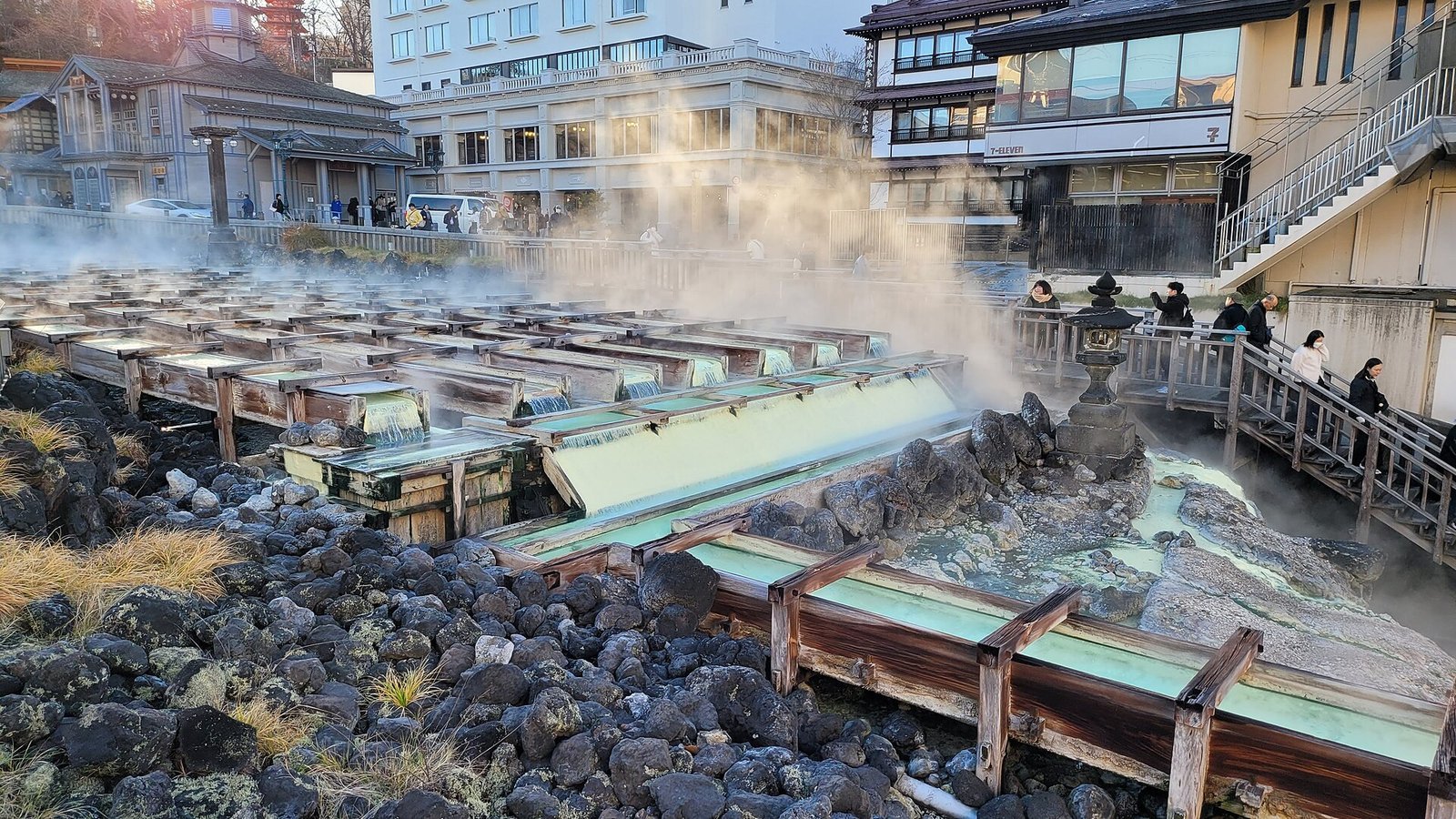
- Kusatsu Onsen – Yubatake (Kusatsu, Gunma) – Steaming hot-water field in the town centre; yumomi shows at Netsu-no-yu. Directions
- Takegawara Onsen (Beppu, Oita) – Historic public bathhouse in central Beppu with a naturally heated sand bath. Directions
- Dogo Onsen Honkan (Matsuyama, Ehime) – Historic wooden bathhouse, fully reopened in July 2024 after preservation work. Directions
- Noboribetsu Jigokudani (Noboribetsu, Hokkaido) – Steaming volcanic 'Hell Valley' next to an onsen town with many spring types. Directions
How to use an onsen, step by step
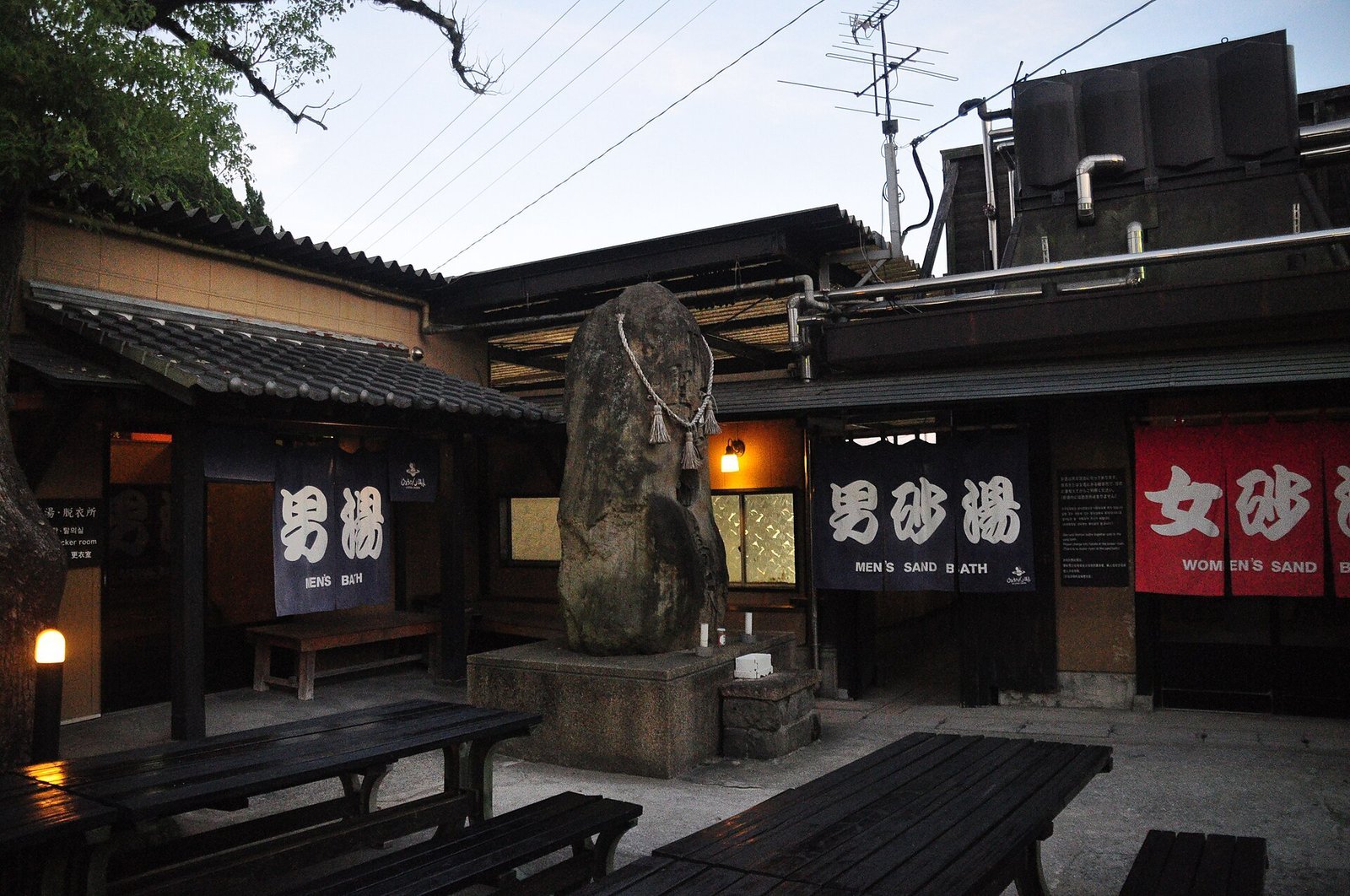
- Take off your shoes at the entrance and put them in a shoe locker. Day-use baths usually sell tickets from a machine or at the desk.
- Find the right curtain. The bath entrances are marked by fabric curtains called noren. Blue usually means men and red means women, but colours vary, so learn the two characters: 男 (otoko, men) and 女 (onna, women). At some ryokan the men’s and women’s baths swap over at set times, so check the sign each time you go in.
- Undress in the changing room. Everything goes in a basket or locker, including the big towel. Take only your small towel into the bathing area.
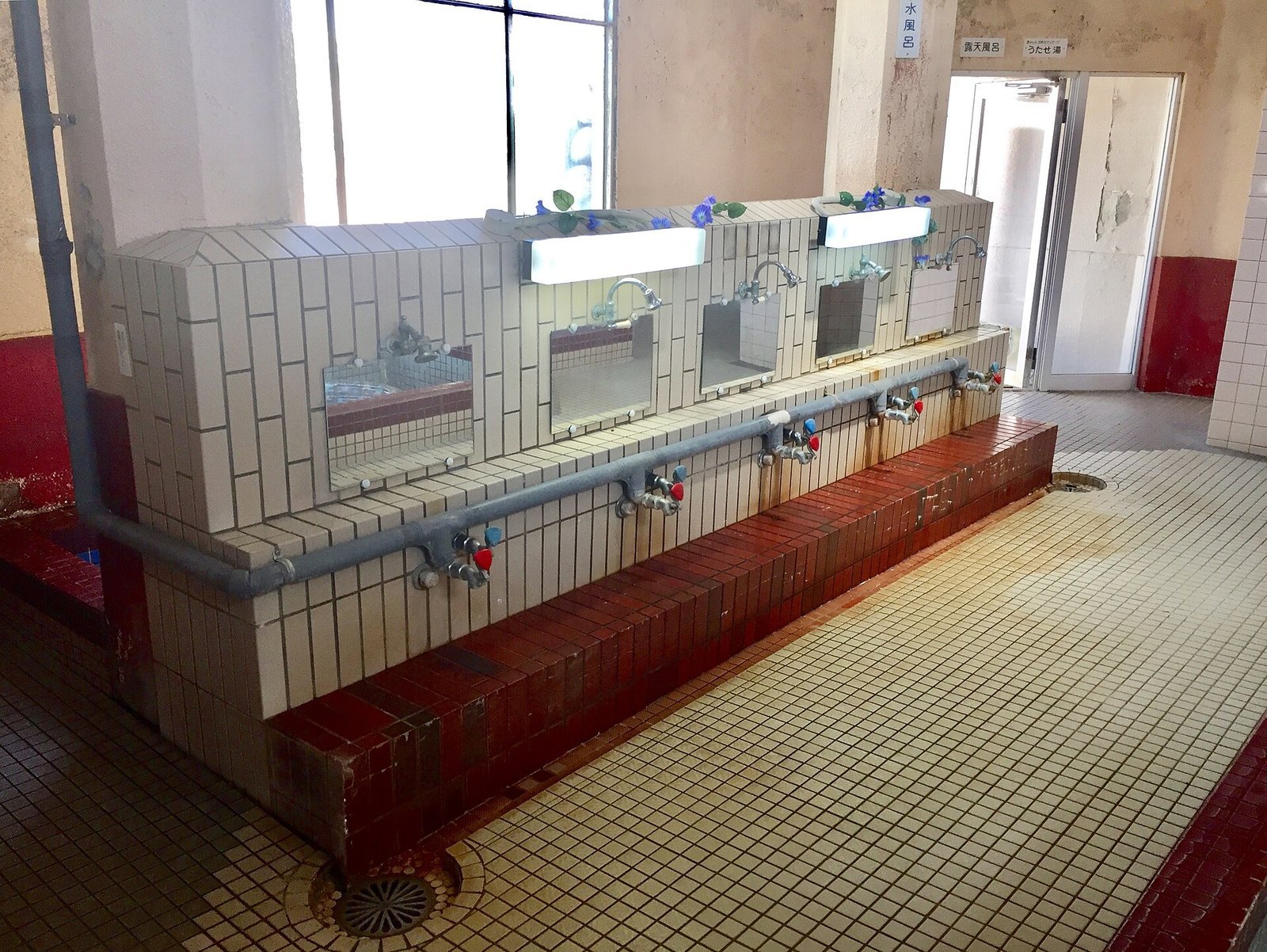
- Wash at the wash station, sitting down. Grab a stool and bucket, sit at a tap, and wash your body and hair thoroughly. Rinse off every bit of soap, without spraying your neighbour.
- Pour water over yourself (kakeyu). Scoop water from the bath and pour it over your feet and legs first, then your body, to get used to the heat.
- Ease in and soak. Slide in slowly. The small towel goes folded on your head or on the edge, never in the water. Keep your head above the surface.
- Rest and drink water. Get out slowly and cool down. Many people go in and out a couple of times.
- Dry off before the changing room. Wipe yourself down with the wrung-out small towel so you don’t drip on the floor, then use your big towel.
Onsen do’s and don’ts
Do
- Tie up long hair so it stays out of the water.
- Keep your voice down. Quiet chat is fine.
- Read the posted house rules and spring information.
- Drink water before and after bathing.
Don’t
- Wear a swimsuit or underwear in a normal onsen.
- Put your towel or your head in the water.
- Swim, dive or splash.
- Take a phone or camera into the bath or changing room. Photographing other bathers is a serious breach.
- Wash clothes, shave or dye your hair at the wash station, unless the sign says shaving is fine.
- Bathe drunk, or straight after a big meal.
- Leave your stool and bucket messy. Rinse them and put them back.
Onsen vs sento, and the types of bath you’ll meet
In everyday speech, an onsen is a hot spring and the baths built around one. Japan’s Hot Springs Act (1948) gives it a legal definition: water, steam or gas coming out of the ground that is at least 25°C at the source, or that contains at least one of 19 listed substances in a set amount, such as iron, sulfur or radon.
A sento is a neighbourhood public bathhouse. Most use ordinary heated tap or well water rather than spring water, though some do pipe in onsen water. The etiquette is the same as at an onsen, and that includes bathing naked.
Here are the main types of bath you’re likely to see:
- Uchiyu: the indoor bath.
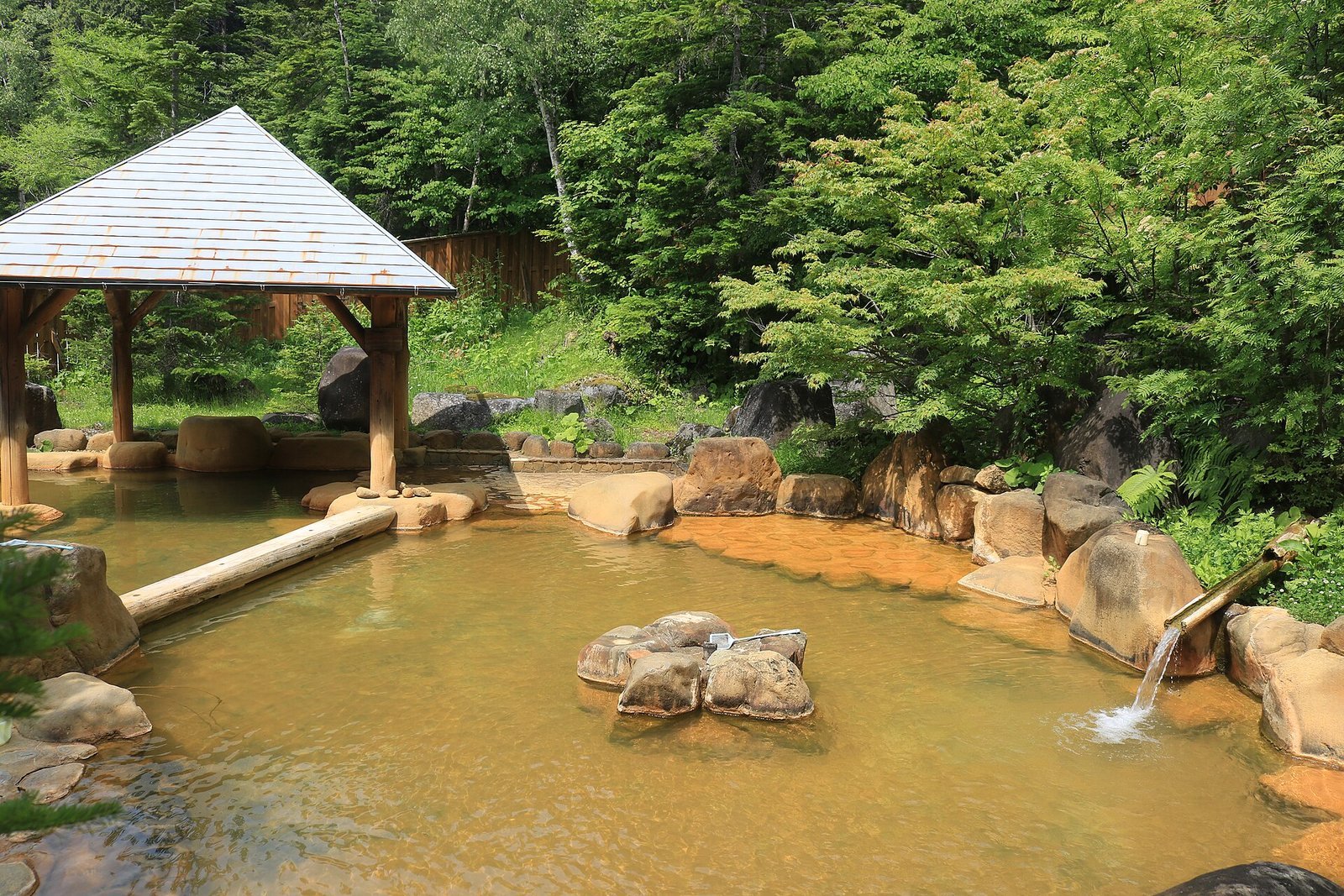
- Rotenburo: an outdoor bath, often with a view of mountains, a river or snow.
- Kashikiri-buro: a private bath you book for a set time slot. Ideal for couples, families, and anyone not ready for a shared bath.
- Ryokan baths: the shared baths at a traditional inn, open to guests and sometimes to day visitors. Some rooms come with their own private outdoor bath.
- Higaeri onsen: day-use hot springs, from simple bathhouses to large complexes with restaurants.
- Super sento: big modern bath complexes with saunas, jet baths and lounges.
- Ashiyu: free or cheap foot baths in onsen towns. Roll up your trousers and sit down, which is a gentle way to start.
By law, every onsen posts a sign with the spring’s components, contraindications and bathing precautions. Many also list conditions the water is traditionally said to help (tekiosho); treat those as tradition, not medical claims.
If a whole ryokan stay appeals, our guide to Kyoto’s most authentic ryokans is a good place to start.
Towels, swimsuits and what to bring
You’ll deal with two towels:
- The small towel (a tenugui or face towel) goes into the bathing area with you. Use it to wash, to cover yourself as you walk around, and to dry off before you go back to the changing room. It never goes in the bath water. While you soak, fold it on your head or leave it on the edge of the bath.
- The big bath towel stays in your basket or locker in the changing room.
Ryokan and hotels provide both towels. Day-use baths often rent or sell them, and basic bathhouses may have none. At a ryokan you can usually walk to the bath in the cotton yukata robe provided.
Swimsuits are not allowed in a standard onsen or sento. The main exceptions are swimsuit zones at onsen theme parks such as Hakone Kowakien Yunessun, and some traditional mixed baths that let you wear a special bathing garment (more on that below).
A few things that help:
A thin cotton tenugui works as your small towel, it dries quickly, and it makes a nice souvenir if you get one with a classic Japanese pattern.
Check price on Amazon – Japanese Tenugui Cotton Towel
A small quick-dry mesh bag keeps your own toiletries together, so you can carry them to the wash station and get a wet towel back to your room without soaking everything else.
Check price on Amazon – DV Lifestyle Mesh Shower Bag
For planning which onsen towns to fit into your route, the current Lonely Planet Japan (19th edition, 2026) covers the major spa towns and how to reach them.
Check price on Amazon – Lonely Planet Japan (19th ed.)
Also bring a hair tie, and a few coins for lockers and hairdryers.
Onsen and tattoos
It depends on the facility, and things are slowly getting easier.
In a 2015 survey of hotels and ryokan by the Japan Tourism Agency, about 56% said they refused bathers with tattoos, about 31% allowed them, and about 13% allowed them on conditions such as covering up. In 2016 the agency published guidance for operators. It said that refusing someone only because they have a tattoo is not appropriate, and it suggested options such as cover-up stickers, private baths and quieter time slots.
In Japan, tattoos have long been linked with organised crime, and many baths adopted blanket bans partly to reassure their regular customers. Attitudes are shifting, but the rules still vary from place to place.
What we suggest:
- Check before you go. Look on the facility’s website or ask at the desk. Policies are often listed in English as “tattoo” or in Japanese as 入れ墨 (irezumi).
- Cover small tattoos where allowed. Some places accept a skin-coloured cover patch or sticker over a small tattoo. Others won’t allow tattoos even if they’re covered, so ask first.
- Book a private bath. A kashikiri bath, or a ryokan room with its own bath, avoids the issue completely.
- Choose tattoo-friendly towns. Kinosaki Onsen’s official tourism site says visitors with tattoos are welcome at all seven of its public bathhouses (individual ryokan set their own rules).
Mixed bathing and children
Almost all public baths in Japan today are separated by gender. Mixed bathing (konyoku) is a traditional custom, not a new one, and it has been in decline for years. It survives mostly at old rural hot springs, particularly in Tohoku. Examples include Tsurunoyu at Nyuto Onsen in Akita and Sukayu Onsen in Aomori, where the huge wooden Hiba Sennin-buro is mixed.
Some mixed baths now allow, or sell, a special bathing garment called yuami-gi, and some set aside women-only hours. Sukayu, for example, sells yuami-gi and runs women-only hours (check the times locally). In 2022 the Ministry of the Environment even trialled everyone wearing bathing garments at Sukayu. The rules vary from bath to bath, so read the sign: at some mixed baths towels aren’t allowed, and many don’t allow you to bring your own bathing wear.
Children: Under national public-bath hygiene guidelines, revised in December 2020, boys and girls aged about 7 and over should not use the bath of the opposite sex. Before that the age was about 10. Prefectures put the change into their own rules on different dates, so some baths may set a slightly different age. With an older child of the opposite sex, a family private bath is the easy answer.
Health and safety
The Ministry of the Environment’s bathing precautions, posted at every onsen, boil down to this:
- Temperature: Most baths are around 40 to 42°C, and some are hotter. Elderly people, and anyone with high blood pressure, heart disease or a history of stroke, should avoid baths of 42°C or more.
- Kakeyu first: Pour water over your hands and feet before you get in, to get used to the heat.
- Soak time: Start with short soaks of about 3 to 10 minutes and build up to 15 to 20 minutes once you’re used to it.
- Alcohol and food: Avoid bathing right after drinking, and never bathe drunk. Avoid bathing right before or after a meal.
- Hydration: Drink a glass of water before and after your bath.
- Standing up: Get out slowly to avoid dizziness. If you feel faint, keep your head low, get out carefully and lie down.
- Elderly people and children shouldn’t bathe alone.
- When to skip it: The official guidance says not to bathe while you have an active illness (especially with a fever), during an acute flare-up of a chronic illness, or when you are bleeding.
Rinsing afterwards: The official advice is not to rinse the spring water off, but to pat yourself dry and rest. If you have sensitive skin, though, rinse with fresh water after strongly acidic or sulfur springs.
Pregnancy: Many older guides, including an earlier version of this one, say onsen are off limits during pregnancy because of the minerals. That is out of date. In 2014 the Ministry of the Environment removed pregnancy from the general list of conditions for which onsen bathing should be avoided. The usual cautions about heat, dizziness and slippery floors still apply, so check with your doctor or midwife, keep soaks short and not too hot, and take care on wet stone floors.
Periods: There’s no national rule, and practice varies by facility. Most people skip shared baths on heavy days. A private bath, or the shower in your room, is the easy alternative, and some facilities say tampons or menstrual cups are fine on lighter days. If you’re unsure, it’s fine to ask the staff discreetly.
How much does an onsen cost?
- Sento in Tokyo: 600 yen for adults (age 12 and up) since 1 August 2026, which is the maximum Tokyo allows. Children 6 to 11 pay 200 yen.
- Day-use onsen: roughly 500 to 1,500 yen for a typical public bath, more for big complexes or famous baths. A few examples: Ginzan’s Shirogane-yu is 500 yen, Kusatsu’s Sainokawara outdoor bath 800 yen, Kinosaki’s day pass for all seven public baths 1,500 yen, and day use at Noboribetsu’s Dai-ichi Takimotokan 2,500 yen.
- Onsen theme parks: more again. Hakone Yunessun’s swimsuit zone, for example, starts at 2,500 yen for adults.
- Ryokan stays: these vary hugely by season, town and room. Prices are usually per person and include dinner and breakfast.
Bathing tax (nyuto-zei): Towns with hot springs charge a small local tax. The standard rate is 150 yen per person per day, but each town sets its own amount, and many charge less or nothing for day visitors and children. It’s normally added to your ryokan bill. Beppu uses a sliding scale based on the price of your stay, up to 500 yen per night at the top end.
A few great onsen towns to try
Japan has thousands of hot springs. These seven are spread across the country and easy for first-timers.
Kinosaki Onsen, Hyogo
Kinosaki is built for bath-hopping: guests stroll between seven public bathhouses (sotoyu meguri) in yukata and wooden geta, usually with a free pass from their ryokan. Day visitors can buy a one-day pass. Each bathhouse has its own closing day, and all seven welcome tattooed bathers. Read more in our guide to Kinosaki Onsen town.
Ginzan Onsen, Yamagata
Ginzan is a row of wooden, multi-storey ryokan facing each other across a river, most famous on snowy evenings when the gas lamps come on. The small public bath Shirogane-yu is open in the daytime; the second one, Omokage-yu, is suspended. Winter is so busy that in 2025-26 day-trippers couldn’t drive in and had to take a shuttle bus, so check the current season’s rules. Our Ginzan Onsen guide has more.
Hakone, Kanagawa
Hakone is the easiest onsen area to reach from Tokyo, with Hakone-Yumoto as the gateway and plenty of day-use baths and ryokan with private baths. See our Hakone guide.
Kusatsu Onsen, Gunma
The heart of Kusatsu is the Yubatake, a steaming field of wooden channels in the middle of town where the hot water cools down. Kusatsu says it has Japan’s largest natural flow of hot spring water. At the Netsu-no-yu bathhouse you can watch yumomi, the traditional show where performers stir the water with long wooden paddles to cool it (adults 700 yen). The water is strongly acidic, so if you have sensitive skin, rinse off afterwards.
Beppu, Oita
Oita Prefecture has more hot spring sources and a larger flow than any other prefecture in Japan, and Beppu, with well over 2,000 sources, is its centre. You can be buried in naturally heated sand at Takegawara Onsen (1,500 yen) or tour the “hells” (jigoku), colourful hot pools you look at rather than bathe in.
Dogo Onsen, Ehime
Dogo, in Matsuyama on Shikoku, is one of Japan’s oldest onsen. The wooden Dogo Onsen Honkan bathhouse stayed open through years of preservation work from 2019 and fully reopened in July 2024. The newer Asuka-no-yu and the locals’ favourite Tsubaki-no-yu are close by.
Noboribetsu Onsen, Hokkaido
Noboribetsu sits next to Jigokudani (“Hell Valley”), a steaming volcanic crater you can walk around on boardwalks. The area is known for having an unusually wide range of spring types, about nine. Several big hotels, including Dai-ichi Takimotokan, open their baths to day visitors.
One last fun fact: in many onsen towns you can buy onsen tamago, eggs slow-cooked in the hot spring water until the yolk is just set and the white is silky. And if you want to see Japan’s most relaxed bathers, try our guide to capybara onsen.
FAQ
Do I have to be naked in an onsen?
Yes, in a normal shared onsen or sento, with baths separated by gender. If that’s not for you, book a private bath or try a swimsuit onsen theme park.
Can I go to an onsen with tattoos?
It depends on the facility. Many still refuse them, some allow small covered tattoos, and some, like Kinosaki’s seven public baths, welcome everyone. Check first, or book a private bath.
Can I go to an onsen on my period?
There’s no national rule. Most people skip shared baths on heavy days and use a private bath or shower instead.
Can I go to an onsen while pregnant?
Pregnancy was removed from Japan’s official onsen contraindications in 2014. Heat and slippery floors are still a risk, so check with your doctor and keep soaks short and not too hot.
How long should I stay in the bath?
Start with 3 to 10 minutes and build up to 15 to 20 once you’re used to it. Get out sooner if you feel dizzy.
Should I shower after an onsen?
You don’t have to. Official guidance suggests leaving the spring water on your skin and patting dry. Rinse off if you have sensitive skin and the spring is strongly acidic or sulfurous.
Can my child come into the bath with me?
Under national guidelines, children aged about 7 and over should use the bath for their own gender. Younger children can go in with either parent.
Is a sento the same as an onsen?
No. A sento is a public bathhouse that usually uses heated tap water. An onsen uses natural hot spring water that meets the legal definition. The etiquette is the same at both.