
Disclosure: this post may contain affiliate links. If you buy through them, Chasing Cherry Blossoms may earn a commission at no extra cost to you. Affiliate disclosure.
Quick answer
Naoshima is a tiny island in the Seto Inland Sea, in Kagawa Prefecture, where a giant polka-dot pumpkin greets the ferry, museums are buried in a hill, and Tadao Ando’s concrete has taken root in a fishing village. Most visitors arrive from Uno Port (about 50 minutes by train from Okayama, then a boat of roughly 20 minutes) or from Takamatsu (about 60 minutes by ferry). Reserve Chichu Art Museum tickets ahead of time. It is closed on most Mondays and, per the official calendar as of November 1, 2026, closed for maintenance from January 12 to March 19, 2027. Plan a full day, and check boat times that day.
Key takeaways
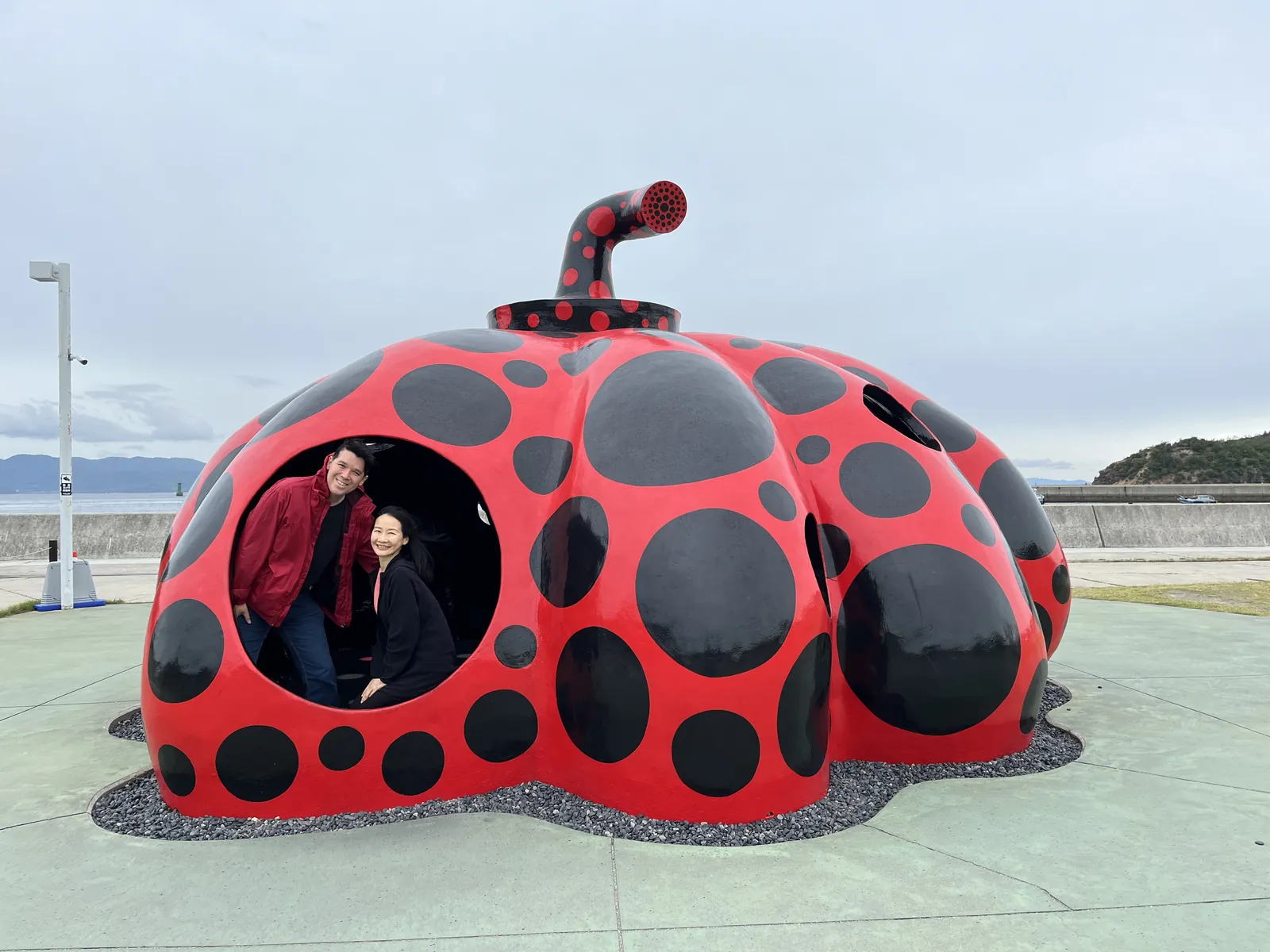
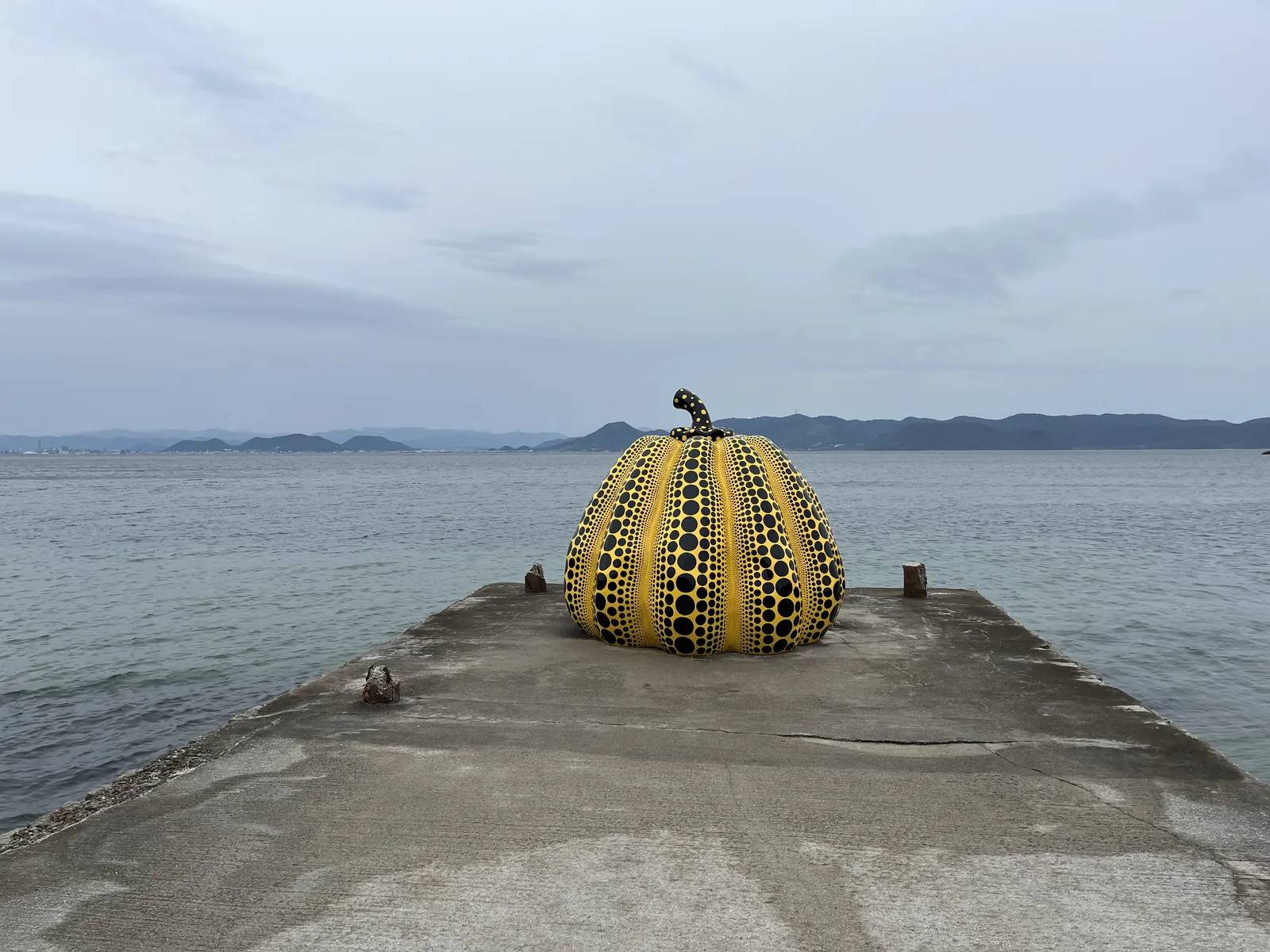
- The red pumpkin at the ferry port is free and always viewable. The yellow pumpkin is a different work, on the pier at Benesse House.
- Chichu requires a timed reservation. If a slot is sold out online, there are no on-site sales that day.
- No photography, video or sketching inside Chichu, the ANDO MUSEUM or Benesse House Museum.
- Uno–Miyanoura is about 20 minutes and ¥370 for adults. Takamatsu–Miyanoura is about 60 minutes by ferry (¥680) or faster by high-speed boat (¥1,590).
- Most museums close Mondays. Check the official calendar for temporary closures before you go.
- Honmura is a lived-in village. Keep your voice low and respect residents’ space.
What Naoshima is, and why people cross the water for it
Naoshima is a small island in the Seto Inland Sea, between Honshu and Shikoku. It belongs to Kagawa Prefecture, even though many travelers reach it from Okayama Prefecture on the opposite shore. Once a quiet fishing community, it is now one of Japan’s best-known places for contemporary art.
The art facilities go by the official name Benesse Art Site Naoshima: a scattering of galleries, outdoor sculptures and restored houses, so the landscape, the sea and village life are part of the visit. Much of that is the work of one architect, Tadao Ando, born in Osaka in 1941 and winner of the Pritzker Prize in 1995. He designed Benesse House Museum (1992), Chichu Art Museum (2004) and the ANDO MUSEUM, plus the Naoshima New Museum of Art, opened in spring 2025, his tenth work on the site.
When we visited, what struck us first was how unhurried it felt after the trains. You step off a boat, and the pace changes. This is a working island, so move through it slowly rather than ticking off sites. For more on Japan’s built environment, see our guide to the architecture of Tokyo.
The Red Pumpkin at Miyanoura vs. the yellow Pumpkin at Benesse House
Naoshima has two famous pumpkin sculptures by the late Yayoi Kusama, and they are not the same work. Benesse Art Site Naoshima has published a note, “In Memoriam: Yayoi Kusama,” honoring her and the images her work gave the island.
The Red Pumpkin dates from 2006 and stands at Miyanoura Port Square, the main ferry gateway. It is outdoor, always viewable and free, and hollow, so visitors can step into its polka-dot openings. In our photo, taken on an overcast day, two visitors sit in those openings with the Seto Inland Sea behind them. The Setouchi Triennale lists it on its official artwork page.
The yellow Pumpkin stands on the pier in the Benesse House Museum area. The original was damaged by a typhoon; Benesse says a new replacement was installed in the same place on October 4, 2022. If you step off the boat and see red, you have the red one. The yellow one is a separate trip.
Chichu Art Museum: a museum buried in the hill
Chichu means “in the earth,” and the name is literal. Opened in 2004 and designed by Ando, the museum is built mostly underground so that it does not spoil the view of the Inland Sea. Visitors move through concrete corridors and spaces lit largely by daylight. The building is often described as one large site-specific work, with art and architecture conceived together for this place.
The permanent collection is small and deliberate: five Water Lilies paintings by Claude Monet, shown under natural light, plus works by James Turrell and Walter De Maria. Photography, video and sketching are not permitted inside, and some spaces require you to remove your shoes.
Chichu hours, closing days and tickets
- Hours: 10:00 a.m. to 5:00 p.m., last admission at 4:00 p.m.
- Closed: Mondays, except when Monday is a national holiday (then it opens Monday and closes the next day). Check the official calendar.
- Extended closure: as of November 1, 2026, maintenance is listed from January 12 to March 19, 2027.
- Admission: weekdays ¥2,500 online and ¥2,800 on site; Saturdays, Sundays and holidays ¥2,700 online and ¥3,000 on site. Children 15 and under are free but still need a reservation.
A date-and-time reservation is required. Online slots run every 15 minutes, and you can buy on the day until 30 minutes before an open slot. If a slot sells out online, there are no on-site sales that day. Payment is by credit card only (VISA, Mastercard or JCB); there are no phone bookings. Tickets for the month after next go on sale at 10:00 a.m. on the 5th of each month — so October tickets, for example, go on sale at 10:00 a.m. on August 5. One booking covers up to eight people.
Tickets cannot be changed or canceled once purchased, except when the facility itself closes, such as when a typhoon stops the boats. A ticket is valid for 30 minutes from the reserved time, and not after. Ferries and buses cannot be booked with the ticket, so leave a cushion — and 30 to 60 extra minutes in peak periods. Benesse House overnight guests still need a Chichu reservation.
ANDO MUSEUM in Honmura: concrete inside a wooden house
Honmura is the island’s older, still lived-in village. Ando inserted a concrete inner space, with a curved ceiling and a skylight, inside a traditional wooden house about 100 years old. From the lane it looks like its neighbors; inside, the old timber and the new concrete sit together, with photographs, sketches and models of his work and of Naoshima’s history.
- Hours: 10:00 a.m. to 1:00 p.m. and 2:00 p.m. to 4:30 p.m., last admission at 4:00 p.m. There is a midday break.
- Closed: Mondays, with the same holiday exception as Chichu.
- Admission: ¥600 online, ¥700 on site; 15 and under free.
- Good to know: no photography, video or sketching inside. There is no restroom in the museum; a public one is near Minamidera.
Honmura is also home to the Art House Project, where artists have turned old houses into artworks. There are seven sites; Kinza is reservation-only. A combined ticket is sold at Honmura Lounge & Archive; confirm details on the official site. Diagonally in front of the ANDO MUSEUM is NAOSHIMA695 / JOIN ART, a small participatory public-art site with a glowing sign, not a Benesse museum. Honmura is not a theme park. Keep voices down, stay on public paths, and do not photograph private homes.
How to get to Naoshima
The two easy gateways are Uno Port on the Okayama side and Takamatsu on Shikoku. Shikoku Kisen operates the boats. Timetables change, so check the schedule on the day you travel. Ferries are first-come, cannot be reserved, and can be canceled in bad weather.
From Okayama via Uno
Okayama is on the Sanyo Shinkansen line. If you are coming from Tokyo, our Tokyo to Hiroshima Shinkansen guide covers the same route, and how to ride the Shinkansen explains tickets and etiquette. From Okayama Station, the JR Uno Line runs to Uno Station in about 50 minutes (Benesse). The official tourism site lists an adult fare of ¥590 and 50 to 57 minutes nonstop, or 47 to 51 minutes with a change at Chayamachi. Uno Station is about a three-minute walk from the port.
The boat from Uno to Miyanoura takes about 20 minutes. Adults pay ¥370 and children ¥190, on both the ferry and the high-speed passenger boat. The two use different piers. A night boat costs more (adult ¥730); do not mix it up with the regular fare. A less frequent passenger boat also runs from Uno to Honmura, about 20 minutes and ¥370 for adults, handy for the ANDO MUSEUM and the Art House Project. If Okayama itself interests you, see our piece on the hidden gems of Okayama.
From Takamatsu
The ferry from Takamatsu to Miyanoura takes about 60 minutes (adults ¥680, children ¥340). The high-speed boat is quicker and costs ¥1,590 for adults and ¥800 for children. The two leave from different piers, so confirm which one you need. Travelers already in western Japan can place Naoshima in a wider Kansai itinerary.
Getting around the island
A town bus connects Miyanoura, Honmura and the Benesse House and Chichu area. Check the current fare locally, and pace yourself on the hills.
Reservations, closing days and a sensible plan
Treat Chichu as the anchor of your day and book it first. Most Benesse Art Site facilities close on Mondays, with the holiday exception noted above. Benesse House Museum is the exception: it is open year-round from 8:00 a.m. to 9:00 p.m., last admission at 8:00 p.m. Admission is ¥1,300 online and ¥1,500 on site, free for ages 15 and under and for Benesse House overnight guests. Photos are not allowed inside. Outdoor works around the complex, including the yellow Pumpkin, can be seen outside.
As of November 1, 2026, the official calendar also lists a temporary closure of the Naoshima New Museum of Art from November 24 until noon on December 12, 2026, for an exhibit change, and a Lee Ufan Museum closure on December 19, 2026. Check the official calendar for your date. A simple one-day plan: arrive at Miyanoura, see the Red Pumpkin, bus to Chichu for your booked slot, then Honmura in the afternoon. Mind the ANDO MUSEUM’s lunch break and 4:00 p.m. last admission.
A quiet place worth slowing down for
Naoshima rewards patience. The pumpkin at the port is a cheerful greeting, Chichu is a lesson in restraint, and the ANDO MUSEUM shows how new and old can share a roof. Book early, leave margin for the boats, and let the village be itself.
Frequently asked questions
Is the Red Pumpkin the same as the yellow Pumpkin?
No. The red one (2006) is free at Miyanoura Port. The yellow one is on the Benesse House pier; a replacement went in on October 4, 2022, after typhoon damage.
Do I need a reservation for Chichu?
Yes, including for children 15 and under, who enter free. Sold-out slots are not sold on site.
Can I take photos inside the museums?
No, not at Chichu, the ANDO MUSEUM or Benesse House Museum. Outdoor works such as the Red Pumpkin are fine to photograph.
How long does it take from Okayama?
About 50 minutes by train to Uno, a short walk to the port, and about 20 minutes by boat, plus waiting time.
Can I do it as a day trip?
Yes, from Okayama or Takamatsu. Reserve Chichu first, confirm the last boat back, and leave margin for weather cancellations.
How much is the ferry?
Uno is ¥370 for adults (children ¥190). From Takamatsu, the ferry is ¥680 and the high-speed boat is ¥1,590 (children ¥340 and ¥800). Confirm fares with Shikoku Kisen.
Sources
- Benesse Art Site Naoshima: Chichu Art Museum
- Benesse Art Site Naoshima: Chichu online tickets FAQ
- Benesse Art Site Naoshima: ANDO MUSEUM
- Benesse Art Site Naoshima: Access
- Benesse Art Site Naoshima: In Memoriam, Yayoi Kusama
- Setouchi Triennale: Red Pumpkin
- Naoshima Town Tourism Association
- Shikoku Kisen (ferry operator): check the current timetable and fares