As an Amazon Associate, Chasing Cherry Blossoms earns from qualifying purchases. We may also earn from other affiliate links on this page at no extra cost to you.
Hiroshima okonomiyaki is not a pancake with things mixed in. It is a stack built in a fixed order: a thin crepe, a mound of cabbage, pork belly and fried noodles, bound with egg and finished with a sweet, fruity sauce. A cook builds it in front of you on a hot steel counter, and you eat it straight off the griddle with a small spatula.
This guide covers what it is, how it differs from Osaka style, where to eat it in 2026, how to order, and how to fit it into a Hiroshima and Miyajima day. Prices are in yen with US dollars at roughly $1 = 155 yen (rounded; check the current rate).
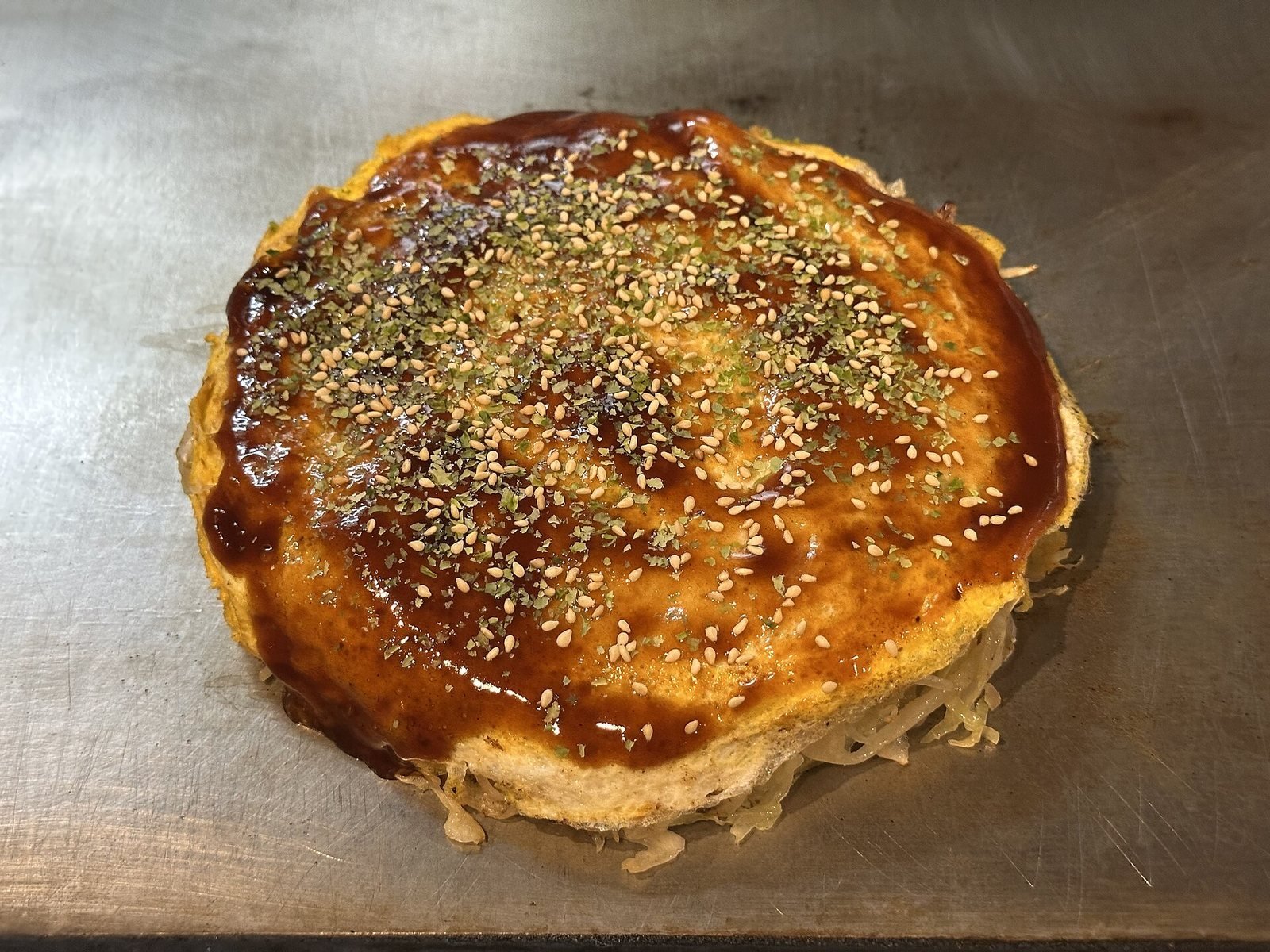
Quick answer: Hiroshima-style okonomiyaki is layered, not mixed. A thin crepe goes under cabbage, bean sprouts and pork belly, then sits on fried soba or udon noodles and a griddle-spread egg, topped with Otafuku sauce and aonori. Osaka style mixes cabbage into a thick batter and usually has no noodles (except modan-yaki). A basic one with pork, egg and noodles costs roughly 900-1,300 yen ($6-8.50) as of October 2026. Okonomimura downtown and the Ekimae Hiroba floor by Hiroshima Station are the easiest places to start. The Nozomi Shinkansen takes about 4 hours from Tokyo and about 1 hour 20 minutes from Shin-Osaka. Pair it with Peace Memorial Park and Miyajima in one day.
| Feature | Hiroshima style | Osaka (Kansai) style |
|---|---|---|
| Method | Layered (重ね焼き, kasane-yaki) | Mixed (混ぜ焼き, maze-yaki) |
| Batter | Thin crepe-like flour batter as a base | Thick batter, often with grated yam and dashi |
| Cabbage | Piled high on the crepe and steamed | Chopped and mixed into the batter |
| Noodles | Standard (soba or udon) | Not usual; only in modan-yaki |
| Who cooks | Usually the chef, at a counter teppan | The kitchen, or you at a table griddle in some shops |
| Thickness and texture | Tall stack; crisp noodles, soft steamed cabbage | About 2 cm (under 1 inch), fluffy and even |
| Typical price (basic, Oct 2026) | About 900-1,300 yen ($6-8.50) | About 900-1,300 yen ($6-8.50); some shops up to 2,000 yen ($13) |
| How it is eaten | Off the griddle with a hera (small spatula) | Off the griddle, or on a plate with chopsticks |
| Sauce | Otafuku (a Hiroshima company) dominates | Mixed; Osaka brands such as Ikari alongside Otafuku and others |
| Where to try | Okonomimura, Hiroshima Station area, Miyajima | Dotonbori, Umeda, Tsuruhashi and neighborhood shops |
Map: where to eat Hiroshima okonomiyaki (plus Peace Park and Miyajima)
- Okonomimura – About 23 okonomiyaki counters on floors 2-4 in Shintenchi; the easiest first stop. Directions
- Ekimae Hiroba (Full Focus Building 6F) – About 13 okonomiyaki shops on one floor, 3 minutes from the station south exit. Directions
- Hiroshima Station / ekie (Reichan, Mitchan, OKOSTA) – Shinkansen hub; ekie has Reichan, a Mitchan branch and Otafuku's OKOSTA cooking class. Directions
- Mitchan Sohonten (Hatchobori main shop) – Okonomiyaki shop with 1950 stall roots near Hatchobori; expect a line at peak times. Directions
- Nagataya – Okonomiyaki by the Atomic Bomb Dome; vegan version on request; closed Tuesdays. Directions
- Atomic Bomb Dome – UNESCO-listed ruin at Genbaku-Dome-mae tram stop; start of a Peace Park walk. Directions
- Hiroshima Peace Memorial Museum – Museum in Peace Memorial Park; 200 yen (~$1.30), opens 7:30; allow 90+ minutes. Directions
- Shukkeien Garden – Historic strolling garden near the station; 350 yen (~$2.30). Directions
- Hiroshima Castle grounds – Main keep closed since 22 Mar 2026; the grounds and moat remain open. Directions
- Otafuku Wood Egg Okonomiyaki-kan – Otafuku's free okonomiyaki museum in Nishi-ku; weekdays only, tours in Japanese. Directions
- Miyajimaguchi (JR station and ferry piers) – JR Sanyo Line stop; ferries to Miyajima (~10 min, 180 yen) leave from the piers just south. Directions
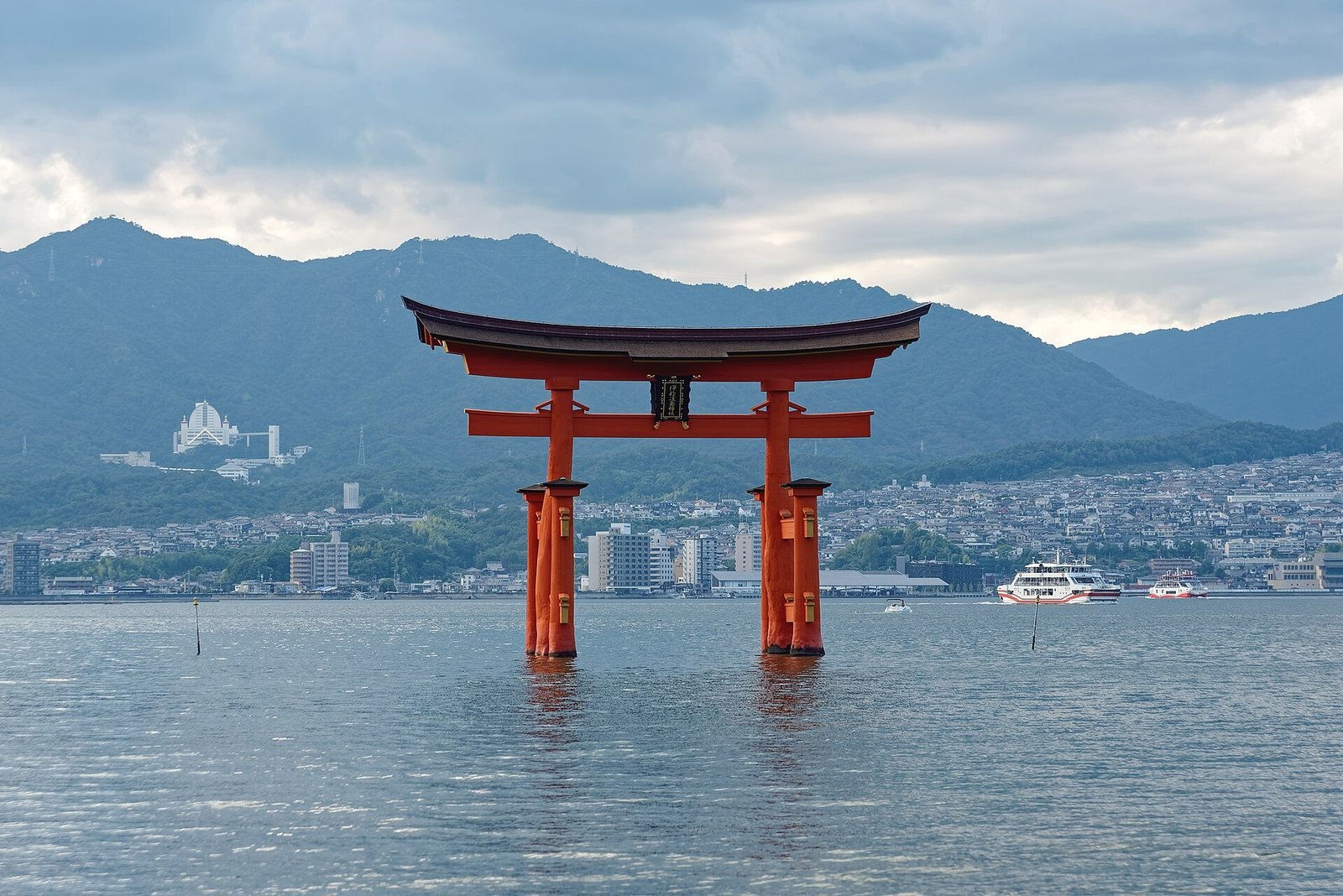
- Itsukushima Shrine (Miyajima) – Floating torii and shrine; admission 300 yen (~$2); pair with oyster okonomiyaki. Directions
What Hiroshima-style okonomiyaki actually is
In Hiroshima it is simply okonomiyaki (お好み焼き), from okonomi (as you like) and yaki (grilled). Visitors often say “Hiroshima-yaki” (広島焼き), but Hiroshima Prefecture’s own website says the dish is neither “Hiroshima-style” nor “Hiroshima-yaki”, just okonomiyaki. Many locals dislike that label, so skip it at the counter. The everyday order in many shops is niku-tama-soba (肉玉そば): pork, egg and noodles.
How it is built, layer by layer
This is the order in Otafuku’s official Hiroshima-style recipe, and roughly what you will see at most counters:
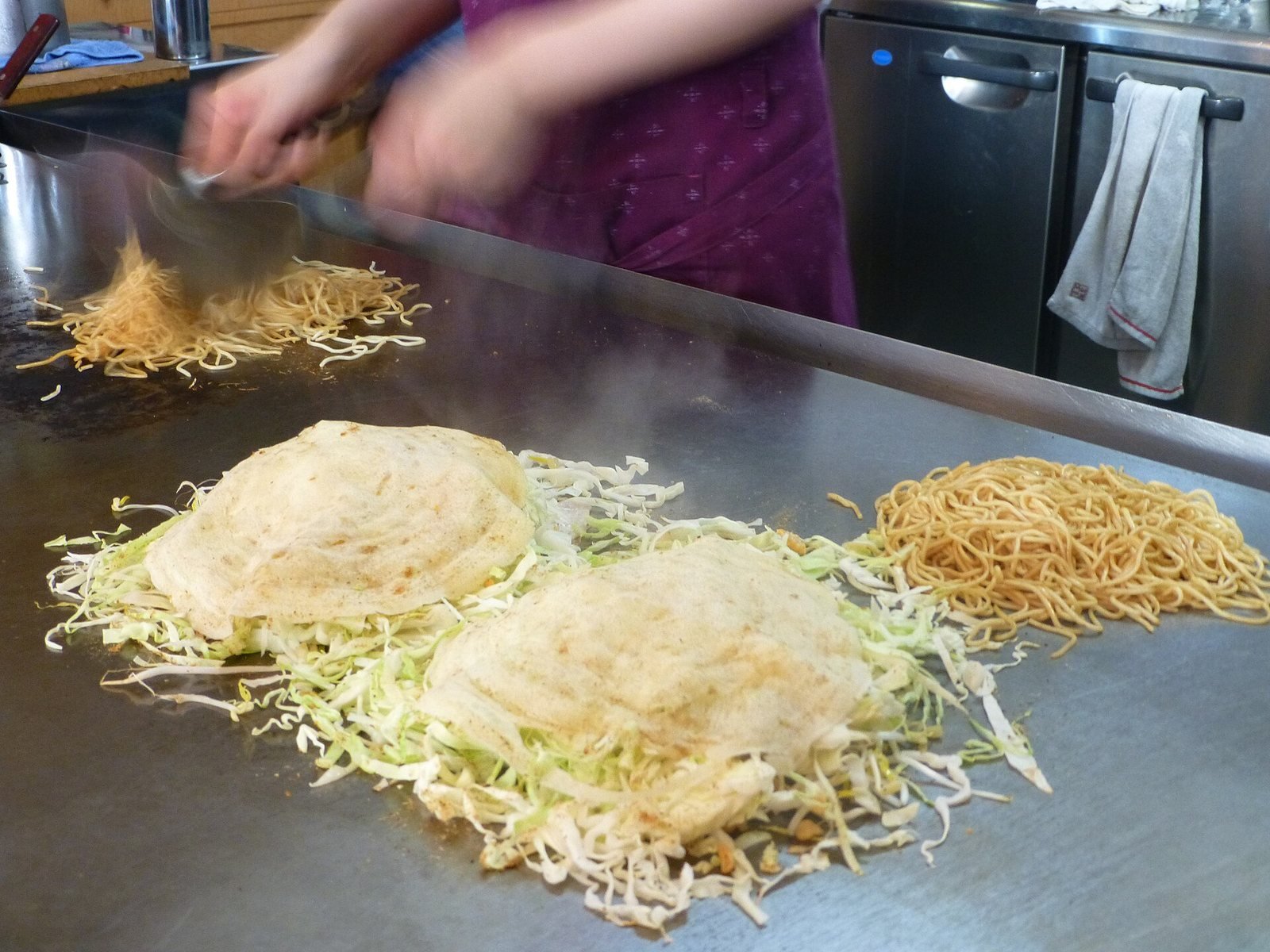
- Thin flour batter is spread into a round crepe on the teppan (griddle) and dusted with bonito powder.
- A big mound of finely shredded cabbage goes on, then tenkasu (crunchy tempura bits), green onion and bean sprouts.
- Thin slices of pork belly are laid on top, with a drizzle of batter to hold things together.
- The stack is flipped so the crepe becomes a lid, and the cabbage steams underneath for several minutes.
- Alongside, noodles (ramen-style soba or udon) are fried, often with a little sauce, and the stack is lifted onto them.
- An egg is cracked onto the griddle, the yolk broken and spread into a round, and the stack is set on top.
- One last flip puts the egg on top. It is brushed with okonomi sauce and sprinkled with aonori (seaweed flakes). Mayonnaise is optional, not standard.
Hiroshima vs Osaka okonomiyaki: the real differences
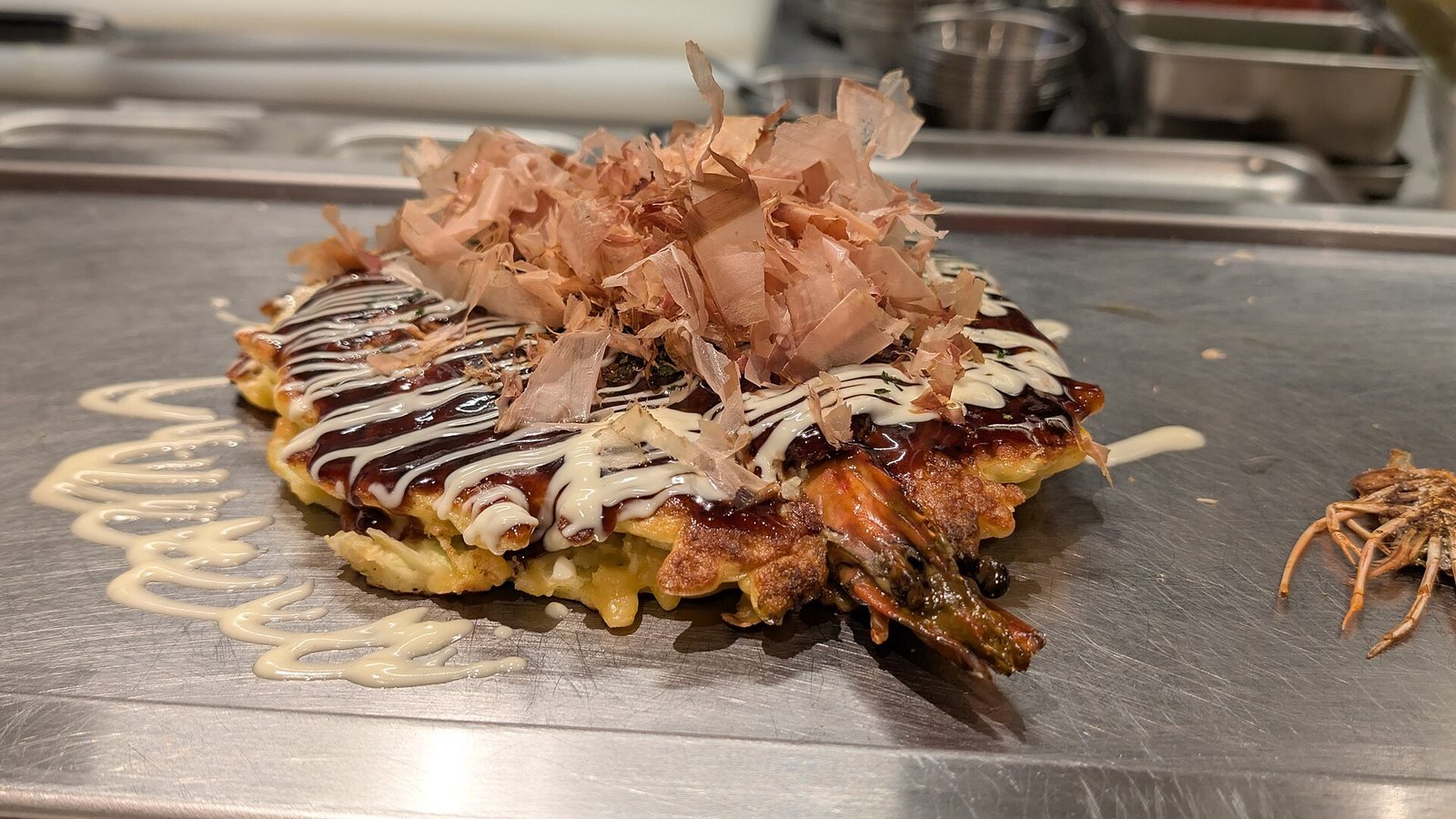
The core difference is layering versus mixing. In Osaka and the rest of Kansai, cabbage, batter (usually with grated nagaimo yam and dashi), egg and fillings are stirred together and cooked as one thick round. In Hiroshima each component is cooked as its own layer.
Noodles cause the most confusion. Modan-yaki (モダン焼き) is a Kansai dish: Osaka-style okonomiyaki with yakisoba added. It is not a twist on Hiroshima okonomiyaki, which already has noodles as standard. Several Kansai shops claim to have invented it.
The setting differs too. In Hiroshima you usually sit at a counter while a cook works the teppan. In Osaka some shops have a griddle at every table, where you or the staff cook. If you are comparing the two cities, see our guides to Osaka takoyaki and Kansai culture and cuisine. Even the spatula’s name differs: mostly hera (ヘラ) in Hiroshima, kote (コテ) in Kansai.
A short history: from children’s snack to full meal
Before the war, children across Japan ate issen yoshoku (一銭洋食, “one-sen Western food”), a thin flour crepe with green onion and sauce sold cheaply at sweet shops. After the 1945 atomic bombing, Hiroshima rebuilt amid severe food shortages, and flour from American aid became a staple. Otafuku’s history of the dish says stall-keepers bulked up the old crepe with cabbage and bean sprouts, then added pork and called it okonomiyaki. Noodles became standard in the late 1950s and early 1960s. Our article on the resilience of Hiroshima tells the wider story of the city’s recovery.
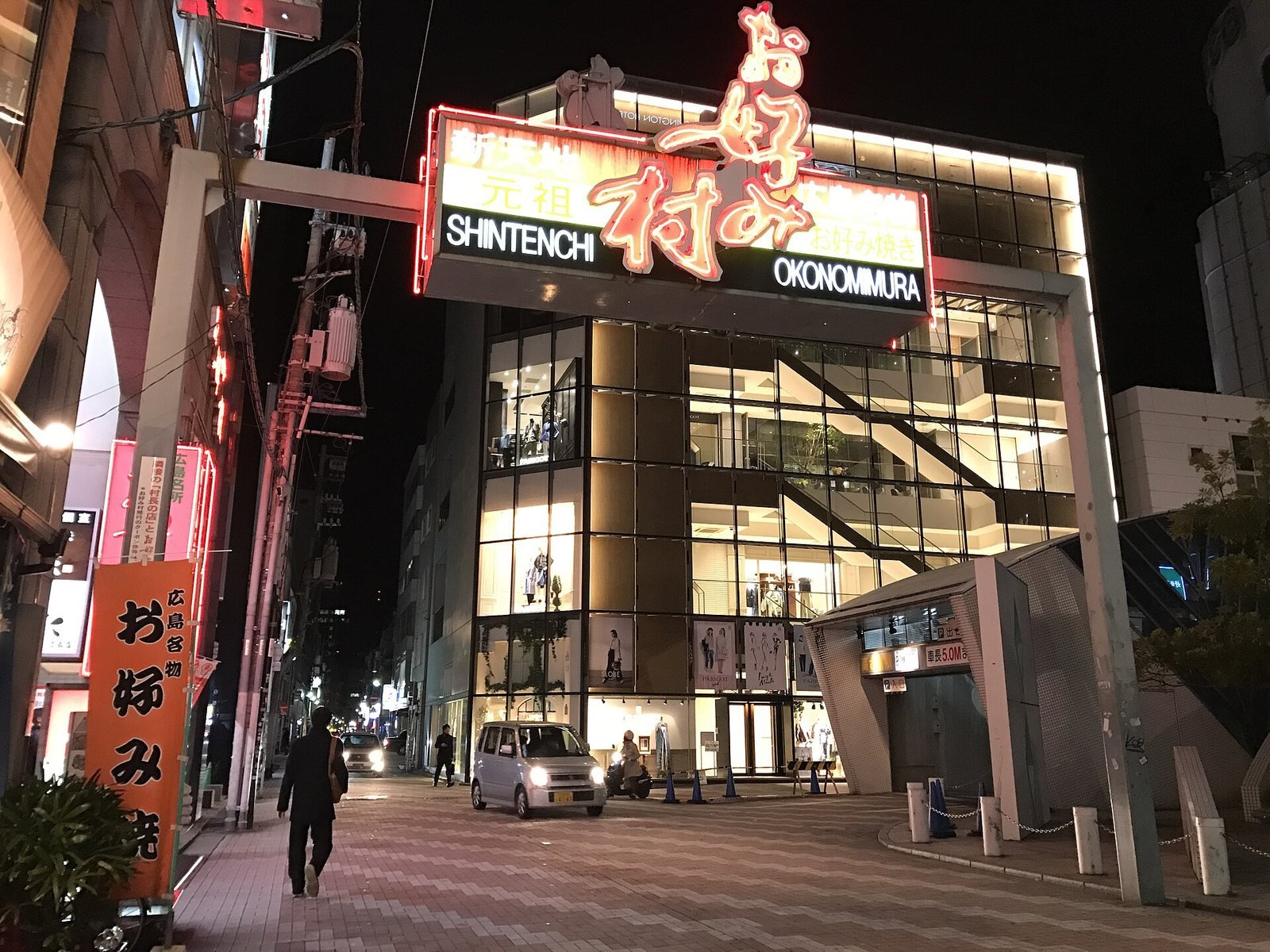
About 50 of those postwar stalls clustered on Shintenchi Square downtown. When the square became a park in the 1960s (sources say 1963 or 1965), they moved into a two-storey building named Okonomimura (お好み村, “okonomiyaki village”). The current building opened in 1992. Hiroshima still has by far the most okonomiyaki shops per person in Japan: a government analysis of 2014 census data counted about 58 per 100,000 residents against a national average of about 13.
Otafuku began in 1922 as Sasaki Shoten in Yokogawa, Hiroshima, launched its okonomiyaki sauce in 1952, and started adding dates (the source of its fruity sweetness) in 1975. Origin stories vary: Mitchan Sohonten, a 1950 stall, says its founder originated the Hiroshima style.
Where to eat okonomiyaki in Hiroshima (2026)
These places were checked against official sites, Tabelog and recent listings in October 2026. Hours change often, so confirm before you go.
| Place | Area | What it’s known for | Typical price (basic) | Tips |
|---|---|---|---|---|
| Okonomimura (お好み村) | Shintenchi, Naka-ku (downtown) | About 23 shops on floors 2-4 of one building | About 900-1,300 yen ($6-8.50) | Each shop sets its own hours; sit at any counter with space |
| Ekimae Hiroba (ひろしまお好み物語 駅前ひろば) | Full Focus Building 6F, 3 min from station south exit | About 13 shops on one floor | About 900-1,300 yen ($6-8.50) | Listed 10:00-23:00 daily (some shops open later); handy around train times |
| Reichan (麗ちゃん) | ekie 1F, Hiroshima Station | Founded 1957; one of the station’s best-known lines | Soba-iri about 980 yen ($6.30) | Go before noon or mid-afternoon |
| Mitchan Sohonten (みっちゃん総本店 八丁堀本店) | Hatchobori main shop; branch in ekie | 1950 stall origins; claims to have originated the style | From about 930 yen ($6) at ekie | The ekie branch suits a tight schedule |
| Hassho (薬研堀 八昌) | Yagenbori nightlife district | Crisp noodles, fluffy cabbage; Tabelog okonomiyaki Top 100 (2025) | Not verified; check menu | Evenings only (from about 4 pm); expect a queue; check closing days |
| Nagataya (長田屋) | Otemachi, by the Atomic Bomb Dome | Peace Park location; vegan okonomiyaki on request | Not verified; check menu | About 11:00-20:00, closed Tuesdays; 30+ min queues at peak |
| Matochan (お好み焼 まとちゃん) | Miyajima, near the shrine exit | Oyster okonomiyaki in season | Not verified; check menu | Mainly lunch (around 11:00-16:00); confirm hours |
| OKOSTA (Otafuku studio) | ekie, Hiroshima Station | Make-your-own class; English classes offered | 2,500 yen ($16) | Book 3+ days ahead; vegetarian, Muslim-friendly and gluten-free versions |
Okonomimura
For a first visit this is the easy choice: with more than 20 independent counters in one building you can usually find seats. Walk the floors and sit wherever a cook waves you in.
Around Hiroshima Station and the Peace Park
Ekimae Hiroba, the okonomiyaki floor just outside the south exit, is still operating in 2026; it did not move into minamoa, the new station building that opened in March 2025 (minamoa’s restaurant floor has one teppanyaki-okonomiyaki shop, Kotejuu, but no okonomiyaki zone). Inside ekie you will find Reichan, a Mitchan branch and Otafuku’s OKOSTA studio. Downtown, Nagataya fits neatly into a Peace Park morning, Mitchan’s main shop is near Okonomimura, and Hassho is the evening pick in Yagenbori.
Miyajima and oysters
Hiroshima is Japan’s top oyster-producing prefecture. Oysters are harvested from about October to May, peaking roughly November to March, and many shops add kaki (牡蠣) to okonomiyaki in season; Matochan on Miyajima lists it. One caveat: in autumn 2025 large numbers of farmed oysters died in parts of the Seto Inland Sea, so supply and prices may be affected this winter.
Cooking classes and the Otafuku museum
OKOSTA at the station is the visitor-friendly option: 90-minute classes for 2,500 yen ($16), with English classes available; book at least three days ahead. Otafuku’s Wood Egg Okonomiyaki-kan (Wood Egg お好み焼館) in Nishi-ku has a free museum on weekdays, but guided tours are in Japanese only and it closes on weekends and holidays.
How to order and eat at the counter
Menus are built around noodles. Soba here means yakisoba-style wheat noodles, not buckwheat; udon is the thick alternative. Order “niku-tama soba” and add extras:
- Soba daburu – double noodles
- Ika-ten (イカ天) – fried squid snack, for crunch
- Negi (ねぎ) – a heap of green onion
- Chiizu (チーズ) – cheese
- Kaki (牡蠣) – oysters, in season
Our guide to what to order at a Japanese restaurant covers general etiquette. When your okonomiyaki is done, the cook slides it in front of you on the griddle. Cut wedges with the hera and eat from it, or ask for a plate and chopsticks. Keep your forearms off the hot steel.
Useful phrases
- Niku-tama soba, onegaishimasu (肉玉そば、お願いします) – Pork, egg and noodles, please.
- Udon de onegaishimasu (うどんでお願いします) – With udon, please.
- Soba daburu de (そばダブルで) – Double noodles.
- Mayonēzu nashi de (マヨネーズなしで) – No mayonnaise.
- Butaniku nuki de dekimasu ka? (豚肉抜きでできますか?) – Can you make it without pork?
- Kādo wa tsukaemasu ka? (カードは使えますか?) – Can I pay by card?
- Gochisōsama deshita (ごちそうさまでした) – Thank you for the meal.
Cash, cards and queues
Many popular shops take cards, but smaller counters may be cash-only, so carry a few thousand yen. Lines peak around noon and early evening; mid-afternoon, or Okonomimura, avoids most waits.
Vegetarian, vegan, pork-free, allergies and gluten
Standard okonomiyaki contains wheat, egg, pork and fish (bonito powder, sometimes dashi). Leaving out pork is easy to ask for, but the shared griddle remains. Verified meat-free options are Nagataya (vegan version on request, per 2025 reviews) and OKOSTA’s vegetarian class. Restaurant okonomiyaki is not safe for celiac diners, since both batter and noodles are wheat; OKOSTA’s gluten-free class is the controlled option. Otafuku markets its US okonomi sauce as vegan and gluten-free, but at least one food-service size lists wheat, so read each label.
Getting to Hiroshima from Tokyo or Osaka
Hiroshima Airport (HIJ) has only a few international routes in late 2026 (Taipei, Hong Kong, Seoul, Cheongju and Hanoi) and none to the US. Most Americans fly into Tokyo (Haneda or Narita) or Osaka (Kansai) and take the Shinkansen:
- Tokyo to Hiroshima: just under 4 hours on the fastest Nozomi; about 19,500-20,000 yen ($126-129) reserved, depending on season, or 18,380 yen ($119) unreserved.
- Shin-Osaka to Hiroshima: about 1 hour 20 minutes by Nozomi; roughly 10,600-11,000 yen ($68-71) reserved.
JR Pass math: the 7-day Japan Rail Pass costs 50,000 yen ($323) online. Since October 2023, Nozomi and Mizuho trains need a supplement ticket: 6,500 yen ($42) for Tokyo-Hiroshima, and about 4,170 yen ($27) for Shin-Osaka-Hiroshima per resellers. Hikari and Sakura trains need no supplement. A Tokyo-Hiroshima round trip alone is about 39,000-40,000 yen, so a pass that also covers Kyoto, Osaka and Miyajima usually pays off. See our Japan Rail Pass guide, or JR Pass vs renting a car if you are considering a road trip.
Getting around: Hiroden streetcars charge a flat 240 yen ($1.55) per adult ride. They take cash or IC cards (Suica, ICOCA, PASMO) but not credit-card tap. A 1-day pass is 700 yen ($4.50). Since August 2025, trams stop inside the minamoa station building.
A one-day plan: okonomiyaki, Peace Park and Miyajima
- Morning: Peace Memorial Park. Take tram 2 or 6 to Genbaku-Dome-mae for the Atomic Bomb Dome, then walk through the park to the Peace Memorial Museum (200 yen, opens 7:30). Allow at least 90 minutes; it is a sobering visit.
- Lunch: okonomiyaki. Nagataya is a short walk from the Dome; Okonomimura is 15-20 minutes on foot.
- Afternoon: Miyajima. JR Sanyo Line to Miyajimaguchi (about 25-30 minutes, around 420 yen), then the JR ferry (about 10 minutes, 180 yen, covered by the JR Pass). Miyajima’s 100 yen visitor tax, in force since October 2023, is collected with the fare; JR Pass holders pay it separately. Itsukushima Shrine admission is 300 yen ($2). Stay for sunset at the torii.
- Optional: Shukkeien garden (350 yen) near the station. Hiroshima Castle’s main keep closed to visitors on 22 March 2026 over age and earthquake safety, but the grounds remain open.
For timing, see our best time to visit Japan guide.
Making Hiroshima okonomiyaki at home
An electric griddle is easiest, but two skillets work. Makes two:
- 1/2 cup (60 g) all-purpose flour whisked with 2/3 cup (150 ml) water or light dashi
- About 5 cups (300 g) finely shredded green cabbage and 1 cup (60 g) bean sprouts
- 4 tbsp tenkasu (optional) and sliced green onion
- 6 thin slices pork belly (about 4 oz / 120 g); thin bacon works
- 2 packs fresh yakisoba or ramen noodles (about 5 oz / 150 g each)
- 2 eggs, okonomi sauce, aonori and bonito powder or flakes
- Heat the griddle to 350-375°F (175-190°C), oil lightly, and spread a ladle of batter into a thin 7-8 inch (18-20 cm) circle.
- Add bonito powder, half the cabbage, sprouts, tenkasu and onion, then 3 pork slices and a spoonful of batter.
- After 2-3 minutes, flip with two wide spatulas. Steam 4-5 minutes, pressing lightly, until the cabbage halves in height.
- Fry one portion of noodles with a splash of sauce into a round, and set the stack on it for 2 minutes.
- Spread an egg into a circle, set the stack on it, flip so the egg faces up, then add sauce and aonori.
Otafuku sauce is sold at most Japanese markets in the US, some Asian grocers and Otafuku Foods’ online store. In a pinch, ketchup, Worcestershire, soy and sugar is a rough substitute.
Research-based picks
We have not tested these; they are based on reviews and listings we checked on amazon.com in late October 2026. The standard 17.6 oz Otafuku bottle was out of stock there, so the smaller size is listed.
Otafuku is the brand most Hiroshima counters use, and the 10.6 oz bottle covers several batches.
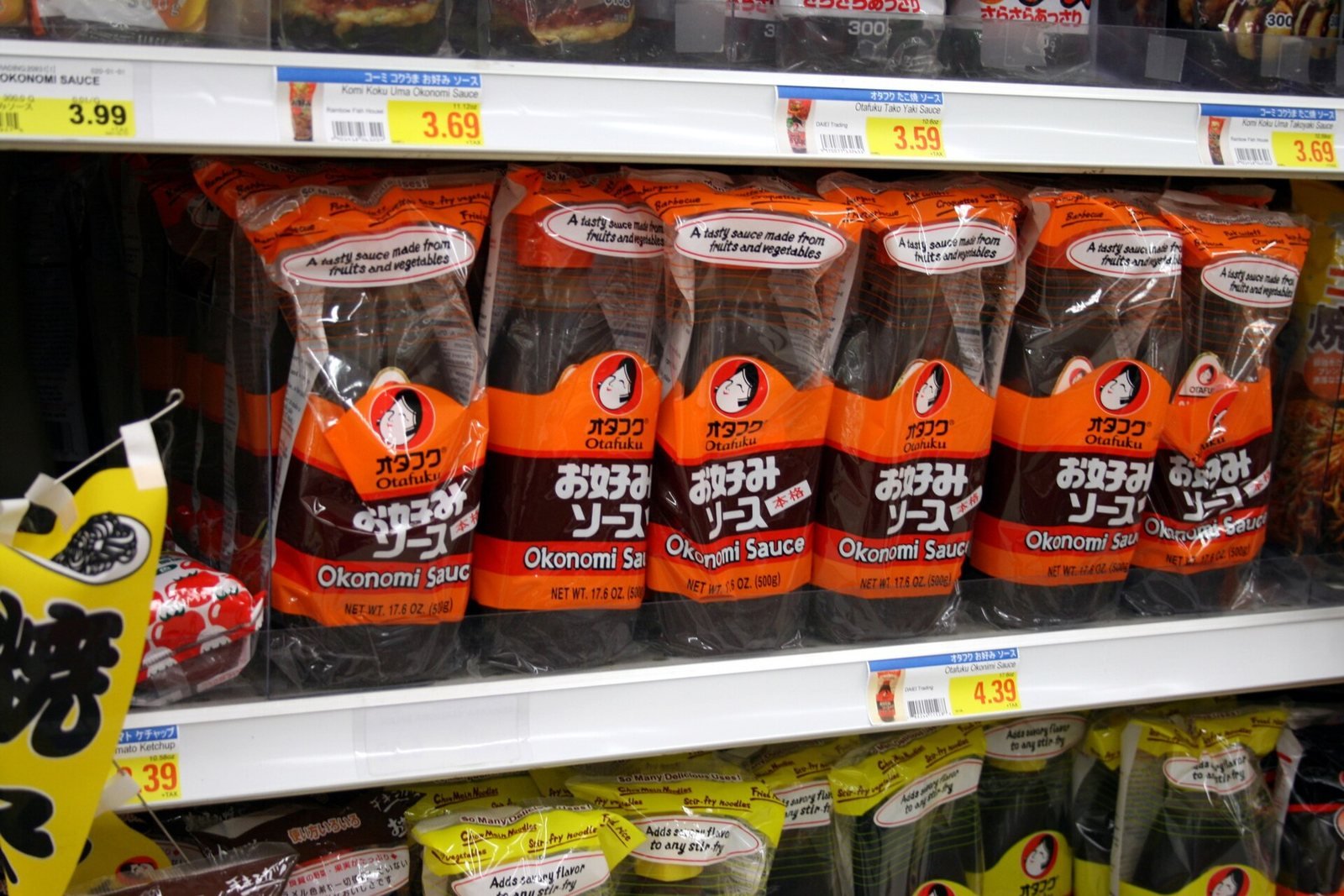
Okonomi sauce at a US Japanese market (item type, not the exact bottle). Photo: Zesmerelda, CC BY-SA 2.0, via Wikimedia Commons
Otafuku Okonomi Sauce (10.6 oz)
The sweet, date-based okonomi sauce most Hiroshima counters use; a smaller bottle for home batches.
Check price on AmazonA small stainless okonomiyaki spatula from Tsubame-Sanjo lets you cut and eat off the griddle the Hiroshima way.
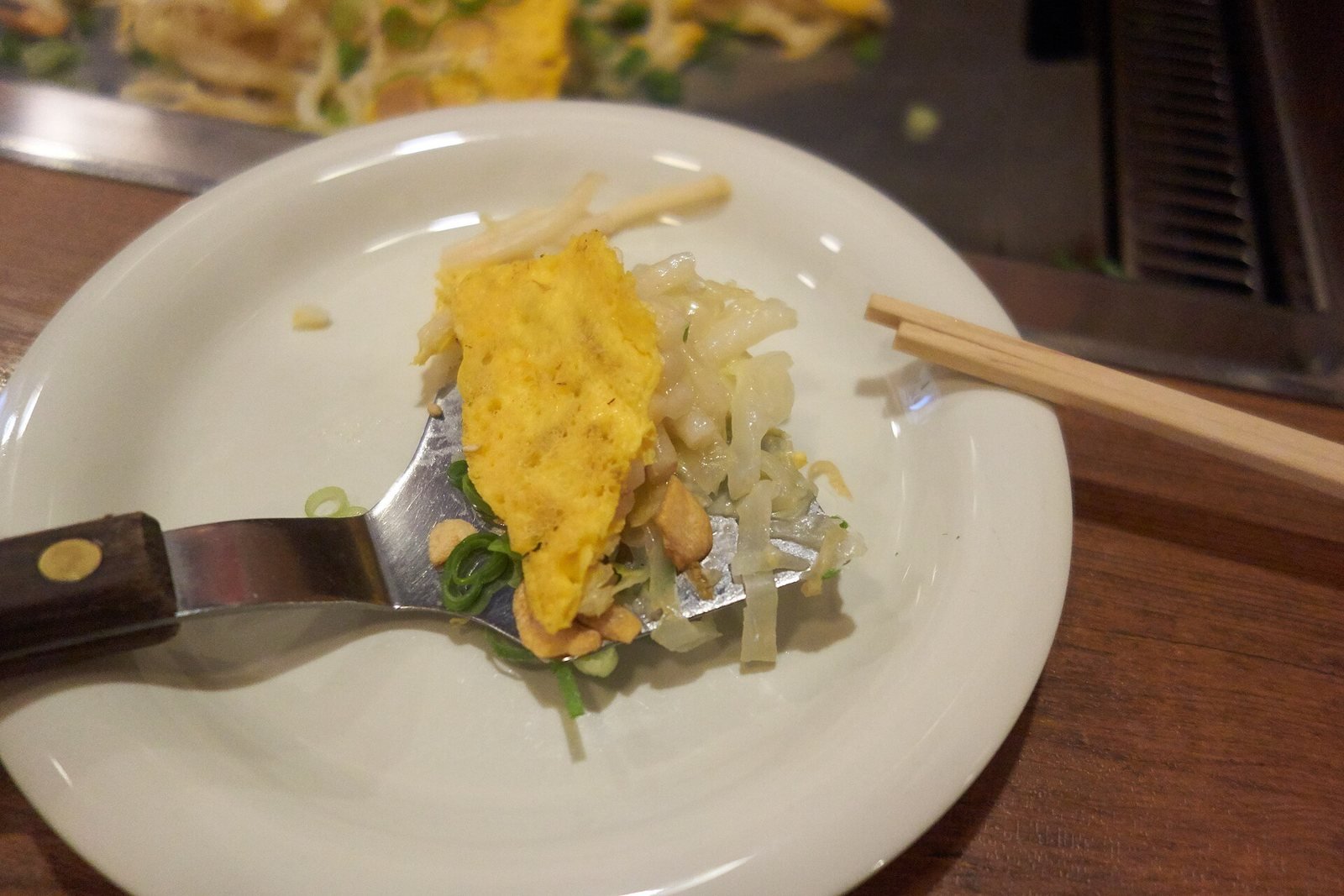
A small okonomiyaki spatula (item type, not the exact model). Photo: Celuici, CC BY-SA 3.0, via Wikimedia Commons
Nagao Tsubame-Sanjo okonomiyaki spatula (12 cm)
Small stainless spatula from Tsubame-Sanjo for cutting and eating okonomiyaki straight off the griddle.
Check price on AmazonA 22-inch electric griddle is the closest a US kitchen gets to a teppan, with room for stack, noodles and egg side by side.
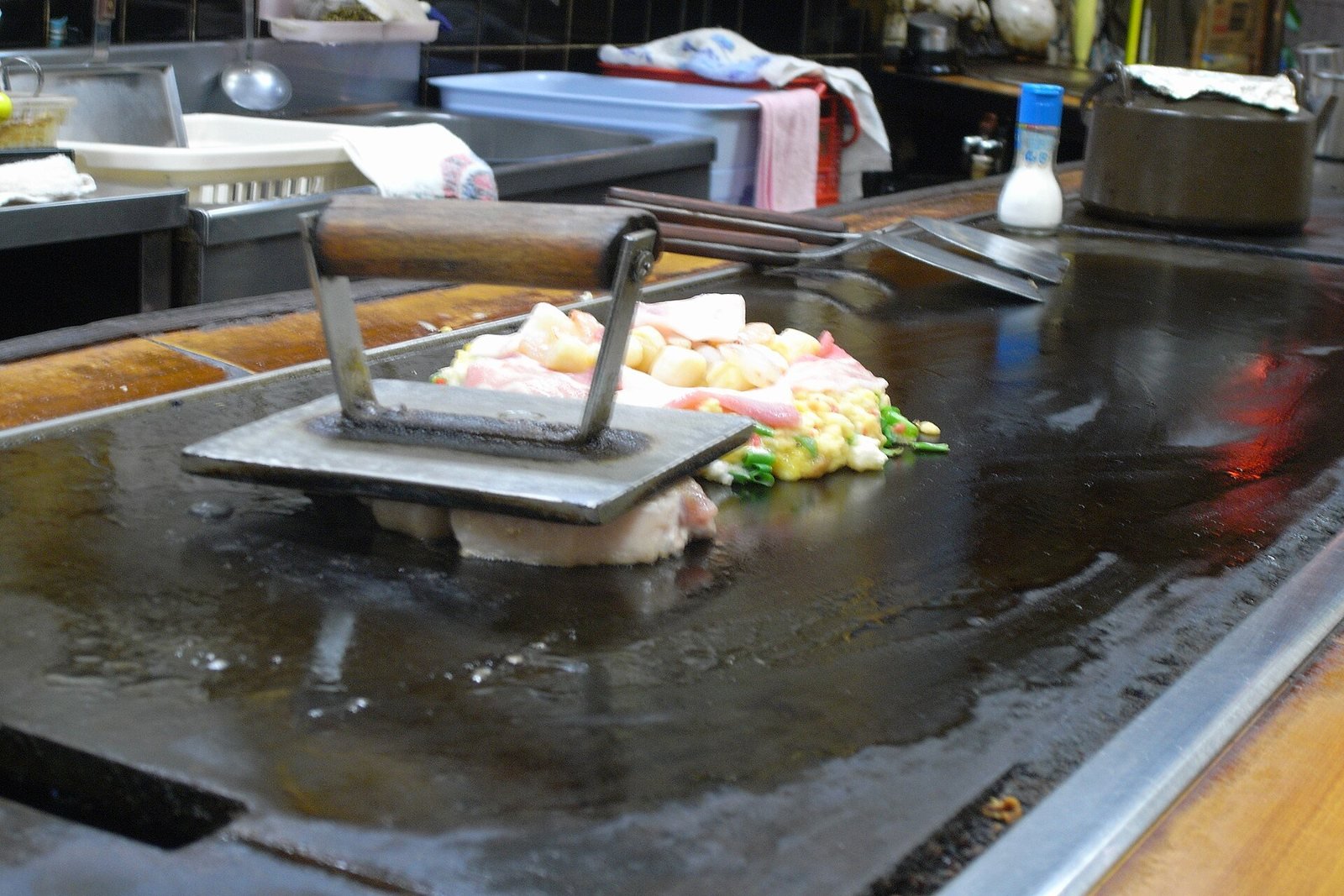
A flat-top griddle (item type, not the exact model). Photo: hirotomo t, CC BY-SA 2.0, via Wikimedia Commons
Presto 22-inch electric griddle
Large flat electric griddle with room for the stack, noodles and egg side by side, teppan-style.
Check price on AmazonFor planning a wider western Japan trip, a general guidebook still helps with routes and sights.
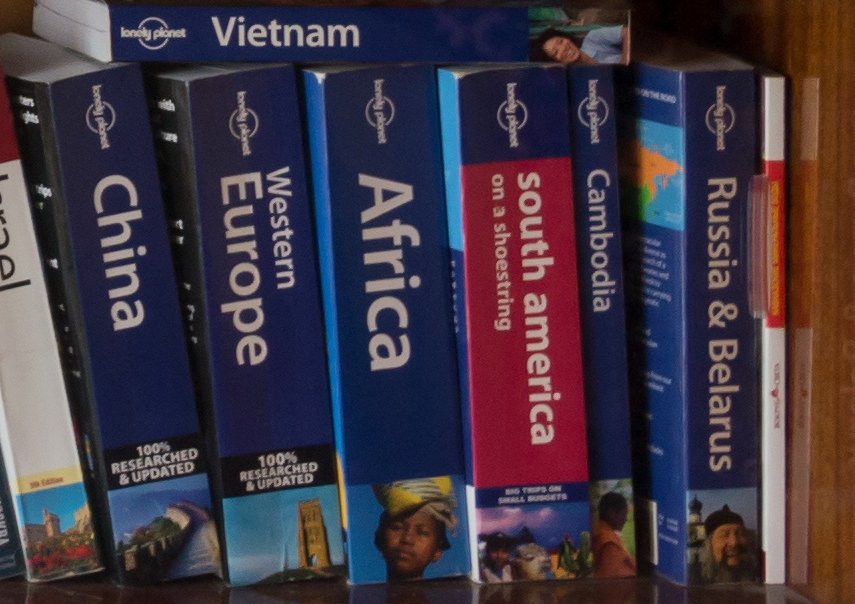
Travel guidebooks (item type, not the exact edition). Photo: Vyacheslav Argenberg, CC BY 4.0, via Wikimedia Commons
Lonely Planet Japan (2026 edition)
Current Japan guidebook for planning a wider western Honshu trip around Hiroshima and Miyajima.
Check price on AmazonHiroshima-style okonomiyaki in the US
It is rarer than Osaka style. Chinchikurin, a Hiroshima chain, lists Los Angeles-area branches (Sawtelle, Little Tokyo, Torrance) and Carrollton, Texas, on its official site. Okonomiyaki Jiban-Ya in Seattle serves both styles (reviewed by The Infatuation in September 2026), and Oconomi in Long Island City, New York, says it serves both. Check current hours before going.
Tips for readers from Singapore, Australia, the UK and Canada
Singapore
There is no direct Singapore-Hiroshima flight; HIJ’s late-2026 schedule has no Singapore service. Fly to Tokyo or Osaka: Singapore Airlines serves Haneda, Narita and Kansai, Scoot flies to Narita, Kansai and (since March 2026) Haneda, and JAL and ANA fly to Tokyo. From Kansai Airport, allow roughly 2.5-3 hours to Hiroshima by rail. Hiroshima also pairs easily with Fukuoka by Shinkansen; see our Fukuoka guide. We could not verify a dedicated Hiroshima-style okonomiyaki restaurant in Singapore in 2025-2026; most local shops serve Osaka style.
Australia
You will most likely land in Tokyo or Osaka, so the Shinkansen math above applies; check current nonstop schedules from your city. On a Tokyo-Kyoto-Osaka loop, price out the 7-day JR Pass, including the 6,500 yen Nozomi supplement each way from Tokyo. Visa and Mastercard work widely, but keep cash for small counters and an IC card for trams.
United Kingdom
Arriving in Tokyo, allow most of a day to reach Hiroshima unless you break the trip in Kyoto or Osaka. Okayama is about 35-40 minutes east by Shinkansen and makes an easy add-on; see our Okayama guide. Allergen labelling at counters is not like the UK’s, so carry a Japanese allergy card listing wheat, egg, pork and fish.
Canada
Most routes go to Tokyo, with some to Osaka; check current schedules. If you have the choice, Osaka is the shorter Shinkansen leg. Shikoku and the Seto Inland Sea islands are a natural extension. Vegetarian and pork-free travelers should plan around Nagataya or OKOSTA.
Is it worth going to Hiroshima just for okonomiyaki?
On its own, probably not on a tight first trip. But Hiroshima also has the Peace Memorial Park, Miyajima is under an hour away, and the city sits on the main Shinkansen line. Okonomiyaki is the cheap, filling meal that ties the day together, and it is best at a counter in its home city. If you are already in Osaka, add one day. If you can’t, try Osaka’s version; our Osaka neighborhood guide covers where to go.
FAQ
What is the difference between Hiroshima and Osaka okonomiyaki?
Hiroshima okonomiyaki is layered: crepe, cabbage, sprouts and pork on fried noodles and egg. Osaka okonomiyaki mixes everything into a thick batter, usually without noodles; noodles appear only in modan-yaki.
How much does Hiroshima okonomiyaki cost?
A basic pork, egg and noodle okonomiyaki is roughly 900-1,300 yen ($6-8.50) as of October 2026. Extras like squid tempura, cheese or oysters push it toward 1,400-1,800 yen ($9-12). Check menus, as prices change.
Where is the best okonomiyaki in Hiroshima?
There is no single best. Okonomimura and the Ekimae Hiroba floor are the easiest starts. Well-known individual shops include Nagataya near the Atomic Bomb Dome, Hassho in Yagenbori and Reichan at the station. Expect queues.
Is Okonomimura worth it?
Yes, for convenience and atmosphere. About 23 independent counters over three floors mean you can almost always find a seat, and they are real working shops.
Is there vegetarian or vegan okonomiyaki in Hiroshima?
Yes, but it is not the default. Nagataya offers a vegan okonomiyaki on request (per 2025 reviews), and OKOSTA runs vegetarian classes. Elsewhere, expect pork, egg, fish and a shared griddle.
What sauce is used, and can I buy Otafuku in the US?
Most Hiroshima shops use Otafuku okonomi sauce, a thick, sweet sauce made with dates. In the US it is sold at most Japanese markets, some Asian grocers, Otafuku Foods’ online store and Amazon, though sizes go in and out of stock.
How do you eat Hiroshima okonomiyaki?
Straight off the griddle with a small spatula (hera): cut a wedge and eat from it. A plate and chopsticks are fine too.
Is okonomiyaki gluten-free?
No. Batter and noodles are wheat and the griddle is shared. OKOSTA offers a gluten-free class, and some Otafuku US sauce is labelled gluten-free, but check each label.